Updated on November 26, 2026
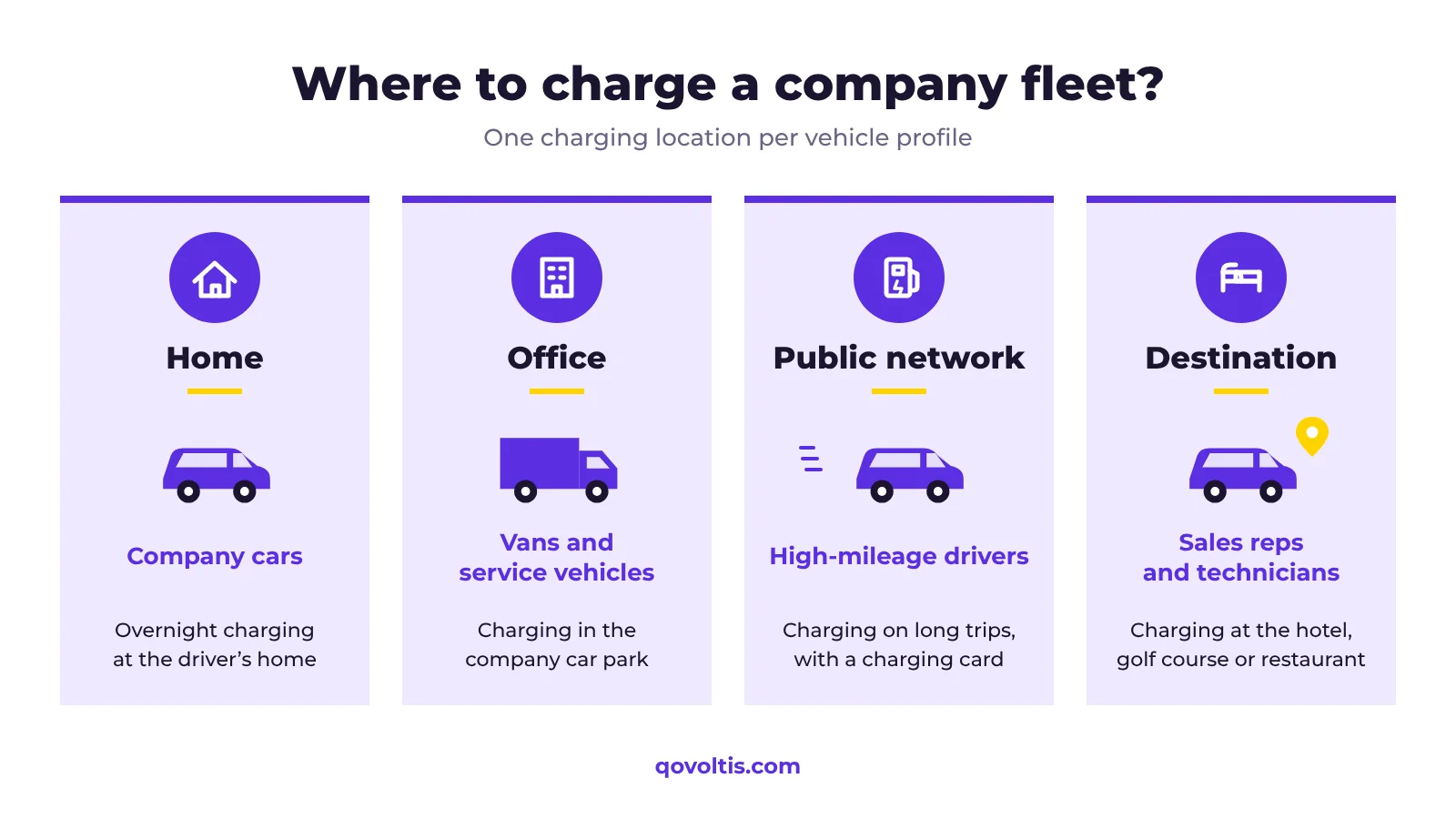
Charging a company fleet is spread across four locations: the employee's home, the company car park, the public network and destination chargers. Each location has its own cost per kWh, its own downtime and its own URSSAF (French social security) regime. For the fleet manager, this choice has a direct impact on the total cost of ownership (TCO): an electric fleet that charges on the fast network by default pays full price for its energy, while an under-equipped car park leaves vehicles idle. Here are the rules for charging an electric vehicle at work, location by location, and the mix that suits each profile.
Where are company fleet vehicles charged?
Company fleet vehicles are charged in four locations: at the employee's home, in the company car park, on the public network and at destination chargers. Each location matches a use, a charging power and an URSSAF regime of its own. Most fleets combine at least two of them.
Should you equip employees' homes to charge company cars?
Equipping employees' homes makes sense for company cars that sleep at the driver's home and have a private parking space. Charging takes place overnight, at low power, with no detour and no waiting. According to the Avere-France and Mobileo survey published in June 2025, 74% of the 51 companies surveyed have rolled out charging at their employees' homes.
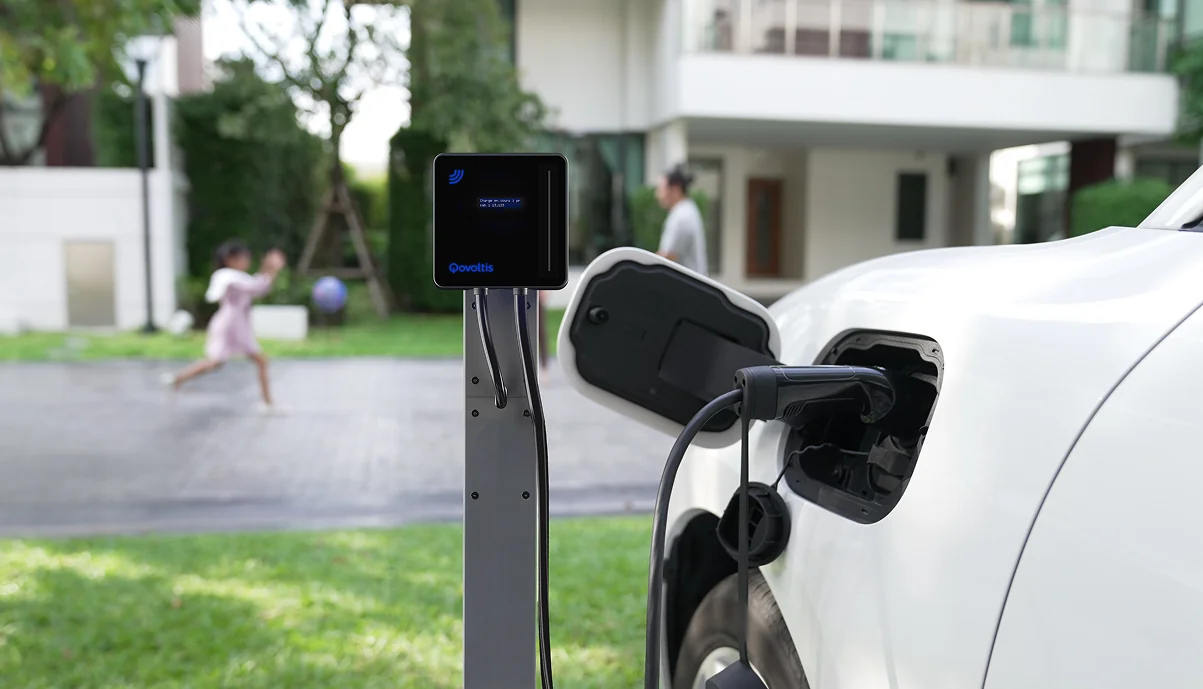
A 7.4 kW charging station recovers about 30 kWh in 4 hours, more than three times faster than a 2.3 kW household socket. The charging station also measures the kWh consumed, which is the basis for reimbursement.
With Qovoltis, home installation is completed within 30 days of the purchase order and the charging station remains the property of the company (see how to install charging stations at employees' homes).
How does the company reimburse the electricity consumed at home?
The company reimburses home electricity at actual cost: the kWh charged, measured by the charging station or by a meter reading, multiplied by the price per kWh the employee pays. URSSAF provides no flat-rate scale in euros for this electricity. The methods and supporting documents are covered in our dedicated article on the reimbursement of home charging costs.
Which employees can have a charging station installed at home?
A home charging station can be installed for an employee who owns or rents their home and has a private parking space. For employees who rent, the steps are detailed in our guide to the charging station for a tenant employee.
Why charge the fleet in the company car park?
Charging the fleet in the company car park lets you control the cost per kWh during working hours. Until December 31, 2027, charging at the workplace creates no benefit in kind, electricity included (Order of February 25, 2025, article 4). It is the reference location for vehicles that return to the site every day.
A fleet charging station of 11 to 22 kW in alternating current also serves, at the company's discretion, employees' and visitors' vehicles. Smart charging lets you install more charging points without increasing the subscribed power.
How many charging points should you install in the company car park?
The number of charging points depends on the kilometers driven and the parking time, not on the number of vehicles. For example, a service vehicle that drives 50 to 80 km a day is charged every two to three days: one charging point for two vehicles on site may then be enough. The full method: fleet charging stations, how many to install.
Does the law require you to equip the company car park?
Yes, with exemptions: car parks of more than 20 spaces at existing non-residential buildings must have at least one charge point since January 1, 2025, on a space accessible to people with reduced mobility, then one point per additional 20 spaces (article L113-13 of the French Construction and Housing Code).
Buildings owned and occupied by an SME are exempt (article L113-14 of the French Construction and Housing Code; Service-Public, sheet F38491). The number of additional points can also be limited if adapting the electrical grid is too costly.
The European EPBD directive (Directive (EU) 2024/1275) provides no exemption for SMEs (article 14, paragraph 5): this exemption may therefore change when the directive is transposed. See our article on the EPBD directive and its effects on company car parks. See also the obligations for company car parks.
When is the public charging network essential for a fleet?
The public network becomes essential for vehicles that cover long distances and for drivers with no private space at night and no charging station at the office. France has 202,804 publicly accessible charge points at the end of September 2026, including 26,803 above 150 kW (Avere-France barometer). For a high-mileage driver, it is a main charging location.
For a driver covering 30,000 km a year, Avere-France uses a typical profile of 40% home charging and 50% on public ultra-fast chargers (half-yearly barometer, November 2025). For most fleets, it remains a top-up: 79% of the companies surveyed by Avere-France and Mobileo consider roaming exceptional. The kWh costs more there than at the office or at home (see the public charging rates).
What is a company fleet charging card?
A company fleet charging card is a badge, physical or digital, that gives access to several public charging networks and groups all drivers' sessions on a single invoice. According to the Avere-France and Mobileo survey published in June 2025, 94% of the companies surveyed provide one to their employees.
What are destination chargers and when should a fleet use them?
Destination chargers are chargers installed where the driver stops for several hours: hotel, golf course, campsite, restaurant or shop. For a fleet, they mainly serve sales reps and technicians on the road, who charge during the hotel night or the client meeting, with no detour to a fast-charging station.
Slow charging in alternating current is enough overnight: choose a hotel with chargers when you book. The Qovoltis network has 3,500 charging stations across 1,300 sites (November 2026), with no inactivity fees. With third-party investment, the car park is open to the public: a fleet driver can charge there without being a customer, via the Qovoltis app (Open or Gold plans) or by bank card with Scan to charge (€40 pre-authorization). The driver pays upfront and then claims the cost through an expense report; the Open plan adds a €2 connection fee per session, Scan to charge has none. See the hotels equipped with Qovoltis charging stations and how to charge at a Qovoltis charging station.
Which charging mix should you choose for your fleet profile?
The right charging mix depends on where the vehicle spends the night and how many kilometers it drives each day. A vehicle that returns to the depot charges at the office; a company car charges at home first; a high-mileage driver adds the public fast network and destination chargers on the road.
Examples of reasoning, to adapt to your own use:
- Vans parked overnight at the depot: one charging point per vehicle, since all of them charge the same night.
- Service vehicles driving 50 to 80 km a day: one charging point for two vehicles on site may be enough.
- Company cars with a home charging station: charging at home, and for example one point at the office for five vehicles on site.
- High-mileage drivers: home charging station, charging card and destination chargers.
Qovoltis installs charging stations at the office and at your employees' homes and sizes the mix after an audit of your sites and usage.
How do you manage charging for a fleet spread across several locations?
Charging spread across several locations is managed from a single supervision platform: a badge per driver, kWh tracking by location, declaration of sessions as business or personal use, and automatic invoicing. See how to bill employees for charging.
FAQ
Can you charge your personal electric car in your company's car park?
Yes, if the employer allows it: until December 31, 2027, this free charging creates no benefit in kind, including for a vehicle owned by the employee (Order of February 25, 2025, article 4; BOSS, Benefits in kind, § 930). The employer can also bill employees for it.
Does charging a company electric car at home create a benefit in kind?
Not for the electricity: for a 100% electric company car, the electricity paid by the employer is not included in the benefit-in-kind calculation, whether it is valued on a flat-rate or an actual-cost basis, for a vehicle made available until December 31, 2027 (Order of February 25, 2025, article 3; BOSS, Benefits in kind, § 910 and 920). See also the reimbursement of home charging costs.
Can you use a single card to charge at all public charging stations?
No, no card guarantees access to 100% of public charging stations. A mobility operator card gives access to many networks thanks to interoperability. Before choosing one, check its coverage on your fleet's actual routes.
Is there financial help to install charging stations for a company fleet?
Not in mainland France: the ADVENIR grant no longer funds charging stations reserved for fleets and employees since January 1, 2023 (advenir.mobi).
Two exceptions: in non-interconnected zones (Corsica, Réunion, Guadeloupe, French Guiana, Martinique, Mayotte and the Ponant islands), a "fleets and employees" grant of 20% remains open, capped at €900 excl. VAT per charge point (advenir.mobi, non-interconnected zones); private car parks for heavy-goods vehicle fleets also have a dedicated grant (advenir.mobi, heavy goods vehicles and coaches). See the other grants for installing charging stations at work.
Which charging station power should you choose for fleet vehicles parked at the office?
An 11 kW alternating-current charging station is enough for a vehicle parked for several hours. A 22 kW power suits short rotations on the same space. See the comparison 7 kW or 22 kW charging station.
Key takeaways
- Company fleet charging is spread across home, the company car park, the public network and destination chargers.
- Charging at work creates no benefit in kind, electricity included, until December 31, 2027 (Order of February 25, 2025, article 4).
- For high-mileage drivers, the public network is a main charging location; for the others, a top-up.
- Charging an electric fleet starts from where each vehicle spends the night and from its kilometers.
Further reading
- Corporate fleet electrification: the 2026 complete guide
- Home charging stations for employees
- Benefit in kind for electric vehicles and charging stations
- Fleet charging stations: how many to install?
- Electric charging prices
- Electric vehicle fleet: the real total cost versus combustion over 5 years
Sources and references
- Order of February 25, 2025 on the valuation of benefits in kind, article 3 (Légifrance, in French)
- Order of February 25, 2025 on the valuation of benefits in kind, article 4 (Légifrance, in French)
- Benefits in kind, § 900 to 930 (Bulletin officiel de la Sécurité sociale, BOSS, in French)
- Article L113-13 of the French Construction and Housing Code (Légifrance, in French)
- Mandatory EV charging infrastructure, sheet F38491 (Service-Public, in French)
- Directive (EU) 2024/1275 on the energy performance of buildings (EPBD) (EUR-Lex)
- Barometer: 202,804 publicly accessible charge points at the end of September 2026 (Avere-France, 10/12/2026, in French)
- Fleet electrification survey (Avere-France and Mobileo, June 2025, in French)
- Half-yearly barometer on the price of publicly accessible charging (Avere-France, P3 and Chargeprice, November 2025, in French)
- Destination charge points for fleets and employees (ADVENIR program, in French)
- ADVENIR grants in non-interconnected zones (ADVENIR program, updated 11/16/2026, in French)
Article written in November 2026. Information verified at the date of publication. The rule on charging at work applies until December 31, 2027, and the electricity rule covers company cars made available until that date; they may change (Order of February 25, 2025, articles 3 and 4). This article is provided for information only and does not constitute legal or tax advice.