Updated on 10/29/2026
A flat-rate reimbursement of home charging costs is only accepted by URSSAF if it is based on the vehicle’s actual consumption: no official scale sets an exempt flat rate for electricity charged at the employee’s home. For a company that is electrifying its fleet and organizing home charging for employees, the stakes are real. A fixed monthly allowance, simple to pay, can be reclassified as additional salary during an inspection, with contributions claimed over the last three years and the current year. Conversely, a clear rule, applied to everyone and backed by readings, secures every euro reimbursed. This guide sets out the URSSAF rule for each type of vehicle charged, the actual-cost calculation method, the supporting documents to keep and the content of a reimbursement policy ready to adapt.
Is there a flat-rate reimbursement of home charging costs accepted by URSSAF?
No, no flat-rate reimbursement of home charging costs is presumed compliant by URSSAF. The order of 4 September 2025 sets flat-rate limits for meals, remote work or long business trips, not for electricity. Only a reimbursement calculated on measured kWh and the actual price per kWh is secure.
For the expenses listed in the order of 4 September 2025, an allowance equal to or below the cap is deemed to have been used for its intended purpose: the employer does not have to produce invoices, but must justify the circumstances that give entitlement to the flat rate (a business trip, remote working days). The French social security official bulletin (BOSS) refers to an irrebuttable presumption (§ 110). Home charging is not on this list: a flat-rate charging allowance therefore benefits from no presumption at all.
The direct consequence: if the employer pays a fixed amount without being able to establish the reality and amount of the expenses, the BOSS states that the allowance becomes additional remuneration, added back into the contribution base for its full amount (§ 100). No official text sets an URSSAF scale in euros per kWh for home charging.
What conditions does URSSAF require to exempt a reimbursement of business expenses?
URSSAF exempts a reimbursement of business expenses under three conditions: the expense is incurred in the interest of the company, its amount is not excessive, and sufficiently precise supporting documents prove its reality and amount. These conditions are set out in the French social security official bulletin (BOSS), in the version in force on 1 January 2026.
The order of 4 September 2025 (article 1) defines business expenses as “special charges inherent to the position or the job”. For each reimbursement, the company must be able to demonstrate:
- the interest of the company: the expense meets a business need, for example charging the vehicle used for customer visits;
- an amount that is not excessive: the reimbursement matches the expense, not a salary top-up;
- proof: supporting documents that establish the reality of the expense and its amount, to be produced in the event of an inspection.
Two reimbursement methods coexist (order of 4 September 2025, article 2). At actual cost, the company reimburses the exact expense on supporting documents, with no exemption cap. As a flat-rate allowance, it pays a fixed amount, exempt without supporting documents only within the limits set by the order; above them, the excess is only exempt if the employer proves it was used for its intended purpose (BOSS, business expenses, § 120).
Which URSSAF rule applies depending on the vehicle charged at the employee’s home?
The URSSAF rule depends on the vehicle. A 100% electric company car made available since 1 February 2025 can be charged at the employer’s expense without contributions until 31 December 2027. For a plug-in hybrid company car, only business charging is exempt. A personal vehicle falls under mileage allowances and the transport bonus.

100% electric company car: can all home charging be reimbursed?
Yes, for a car made available since 1 February 2025. Until 31 December 2027, the employer can cover all the electricity charged at home, personal use included, without contributions, and these costs are not included in the benefit in kind (BOSS, benefits in kind, § 910 to § 930). It only has to prove the kWh and their price.
For an electric fleet, the only condition is therefore proof. A company that measures charging sessions can reimburse 100% of the electricity of its electric company cars without additional social charges. To calculate the benefit in kind itself, see our guide on the benefit in kind of an electric company car.
Plug-in hybrid company car: what share of the electricity can be reimbursed?
For a plug-in hybrid company car, only the electricity charged for business trips can be reimbursed without contributions. Electricity charged for personal use and covered by the employer is added back into the contribution base (BOSS, benefits in kind, § 930). The company must therefore separate business and personal charging in its readings.
Beware of “all-inclusive” offers: if an electricity consumption package is included in a lease or subscription without the electricity share being identifiable, the BOSS counts the whole expense in the benefit in kind (§ 930).
Personal vehicle: mileage allowances or reimbursement of the electricity?
For business trips in a personal electric vehicle, the employer pays mileage allowances based on the tax scale, increased by 20%. For home-to-work commuting without suitable public transport, the transport bonus is exempt up to €600 per year for electricity, with no proof of expense required (€1,000 for amounts paid until 31 December 2026, decree no. 2026-974).
For mileage allowances, the employer must justify the trips and the exact number of kilometers (BOSS, business expenses, chapter 3). The transport bonus is optional and reserved for employees whose usual residence or workplace is in a municipality not served by regular public transport or by a private service set up by the employer (or outside the scope of a mandatory mobility plan), or whose working hours make their personal vehicle essential (article L. 3261-3 of the French Labour Code). When the employer pays it, it must benefit all eligible employees on the same terms (BOSS, business expenses, chapter 4).
Charging station installed at home: what exemption cap in 2026?
A charging station returned to the employer at the end of the contract does not create a benefit in kind. If kept by the employee, its cost is 50% exempt up to €1,057.10, or 75% exempt up to €1,585.50 after 5 years (BOSS, benefits in kind, § 930, 2026 values).
Servicing, maintenance, charging station rental or the extra cost of the electricity subscription are exempt up to 50% of actual expenses. To estimate the benefit in kind of a charging station transferred to an employee, use the Qovoltis benefit-in-kind simulator. For the project steps, see how to install a charging station at an employee’s home.
How do you calculate the actual-cost reimbursement of charging at the employee’s home?
The actual-cost reimbursement of charging at the employee’s home is calculated by multiplying the kWh charged for the vehicle by the price per kWh paid by the employee. The kWh come from a charging station or dedicated meter reading; the price comes from the employee’s electricity bill, taking off-peak and peak hours into account.
Calculation example (fictitious figures, for illustration): an employee charges 180 kWh in the month, including 150 kWh in off-peak hours and 30 kWh in peak hours. If their bill shows €0.20 per kWh in off-peak hours and €0.25 in peak hours, the monthly reimbursement is 150 × 0.20 + 30 × 0.25 = €37.50. For a plug-in hybrid company car, only the kWh from business charging are included in the calculation.
Three points make the difference during an inspection:
- Measured kWh: a time-stamped reading per session, linked to the vehicle, is worth more than an overall estimate based on the household bill.
- The actual price: the rate on the employee’s bill, not a national average rate.
- The extra subscription cost: covering the “extra cost of the electricity supplier subscription needed” is 50% exempt (BOSS, benefits in kind, § 930).
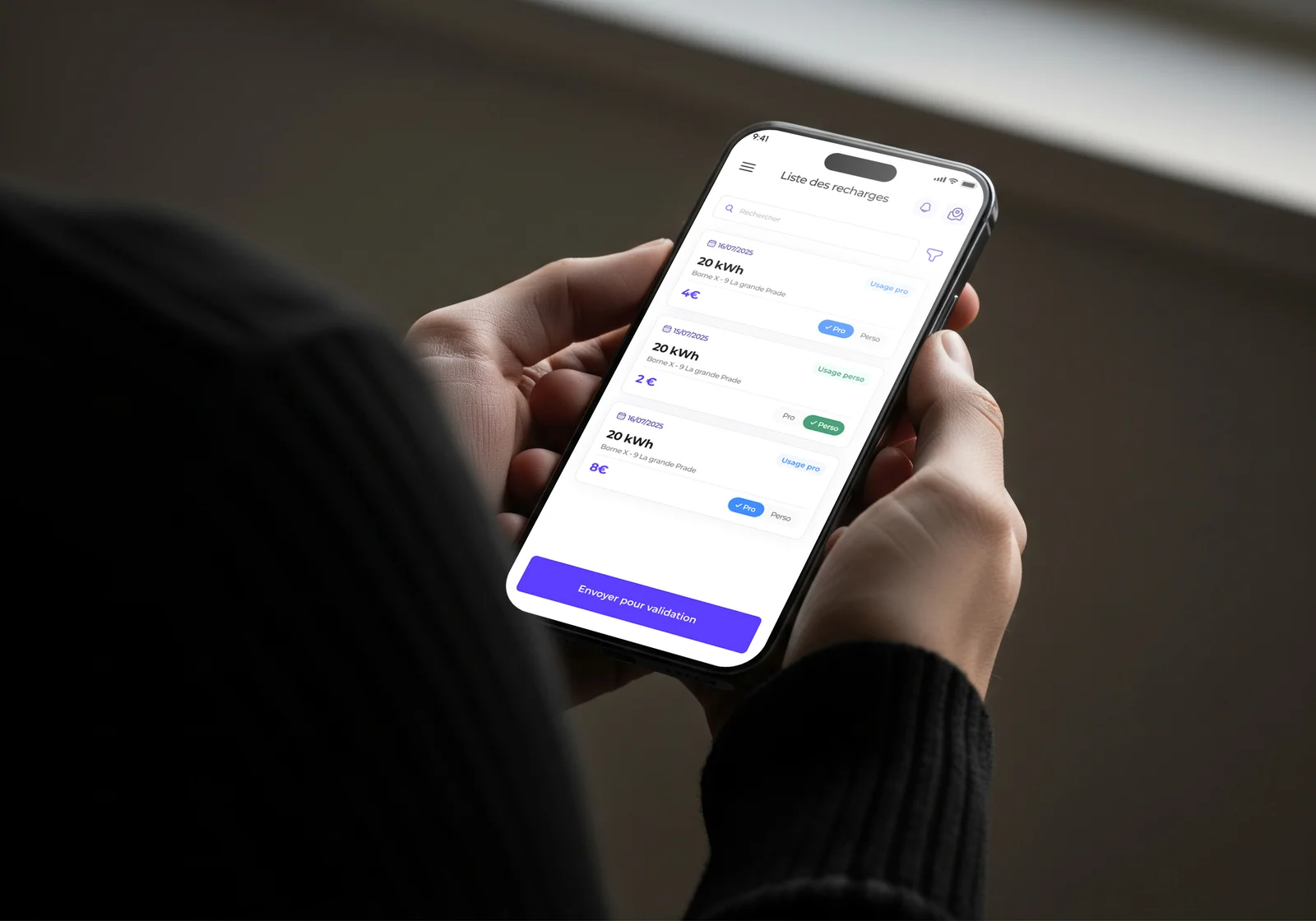
With Qovoltis, each charging station installed at an employee’s home is connected to their Linky meter. This connection precisely measures the kWh charged and automatically calculates the reimbursement amount, based on the actual cost of electricity. URSSAF supporting documents are generated automatically. Each charging station works with a personal badge, and monitoring is centralized in Qockpit. For a 100% electric company car made available since 1 February 2025, all the electricity charged can be reimbursed; for a plug-in hybrid company car, the readings distinguish business and personal kWh. The Qobox P charging station is MID certified.
Can charging be reimbursed without a connected charging station or a dedicated meter?
It is possible, but hard to defend: without measurement, a self-declared reading cannot establish “the reality and the amount” of the expense required by the BOSS (§ 70). At a minimum, the company must keep a written, verifiable calculation method.
Without a connected charging station, some companies rely on the vehicle’s charging data or on a sub-meter. In all cases, it is recommended to write the method into the reimbursement policy, apply it to all the employees concerned and link it to dated data.
Which supporting documents should be kept for charging reimbursements, and for how long?
For each charging reimbursement, the company keeps the kWh reading, the employee’s electricity bill, the calculation details and the approved expense claim. Accounting records are kept for 10 years and tax documents for 6 years; URSSAF can reassess contributions over the previous 3 calendar years and the current year.
A standard charging reimbursement file includes:
- the record of charging sessions (date, duration, kWh, vehicle);
- the employee’s electricity bill, which sets the price per kWh;
- the calculation details and, for a plug-in hybrid, the split between business and personal use;
- the expense claim approved by the manager;
- for a charging station at home, its invoice and the document providing for its return or transfer.

Periods overlap: the longest one applies. Accounting supporting documents are kept for 10 years (French Commercial Code, article L. 123-22), tax documents for 6 years (Service-Public Entreprendre). For URSSAF, contributions are time-barred after 3 years from the end of the calendar year for which they are due (French Social Security Code, article L. 244-3). Reliable, dated digital archiving avoids losing a document at the time of an inspection.
Is the VAT on charging electricity recoverable?
VAT on electricity used by an electric vehicle is deductible under ordinary law conditions (ministerial answer no. 5886 of 27 June 2023). Deduction requires an invoice issued to the company: for charging paid on the employee’s electricity contract, have the recovery validated by your chartered accountant.
The BOFiP BOI-TVA-DED-40-10-10 points out that VAT is only deductible if it appears on an invoice (§ 30) and that only invoices issued to the company justify the deduction (§ 40). The home electricity bill is in the employee’s name: VAT on home charging is therefore, in principle, difficult to recover.
What should an URSSAF-compliant charging reimbursement policy contain?
An URSSAF-compliant charging reimbursement policy specifies the vehicles and employees concerned, the calculation method (measured kWh and price per kWh), the supporting documents required, the submission deadline, the reimbursement frequency, what happens to the charging station when the employee leaves and how long documents are archived.
Written and shared with all the employees concerned, it serves as the reference in the event of an inspection. The 8 points to cover:
- The scope: which vehicles (electric company car, plug-in hybrid, personal vehicle) and which employees.
- The method: reimbursement at actual cost, based on measured kWh.
- The rate used: price per kWh from the employee’s bill, with off-peak and peak hours distinguished.
- Supporting documents: readings, electricity bill, expense claim.
- The submission deadline: for example 30 days after the end of the month (internal rule, no deadline is set by law).
- The reimbursement frequency: monthly or quarterly, and payment date.
- The charging station: ownership, cost coverage, return or transfer when the employee leaves.
- Archiving and control: retention period, person in charge, internal control of expense claims.
What other expenses should the reimbursement policy cover?
The policy also covers meals, remote work and business trips, each with its 2026 exemption limits: €7.50 per meal at the workplace, €10.40 outside the premises, €21.40 at a restaurant during a business trip, €11.00 per month for one day of remote work per week, and the tax mileage scale.
These amounts are set by the BOSS, business expenses (chapter 10) and revalued every 1 January (order of 4 September 2025, article 10). For remote work provided for by a collective agreement, the limit rises to €13.20 per month for one day per week. A single policy, covering charging and other expenses, avoids contradictory rules between departments.
What does the company risk if expense reimbursements are not compliant?
If an expense reimbursement is not justified, URSSAF reclassifies the amount as additional salary and claims contributions on the full amount. On top of this come a late payment surcharge of 5% and 0.2% per month, over a period that can cover the 3 calendar years preceding the inspection and the current year.
The reclassification stems from the BOSS, business expenses (§ 100): without proof of business expenses, the allowance is part of salary. Late payment surcharges are provided for by article R. 243-16 of the French Social Security Code: 5% of the contributions due, plus 0.2% per month or part of a month of delay. The period that can be inspected stems from article L. 244-3 of the French Social Security Code.
The risk is also tax-related: without a compliant invoice in the company’s name, VAT is not deductible (BOFiP BOI-TVA-DED-40-10-10, § 30).
FAQ
How does an employee get reimbursed for home charging costs?
The employee sends their employer an expense claim with the reading of the kWh charged and their electricity bill, following the method set out in the company’s reimbursement policy. Without a written policy, they ask their HR or payroll department which rule applies to their vehicle.
Does the employer have to charge employees for charging in the company car park?
No, from the URSSAF point of view: until 31 December 2027, personal use of a charging station installed at the workplace does not create a benefit in kind, including for employees’ own vehicles. Charging for it or not remains the company’s choice.
Can the transport bonus be combined with mileage allowances?
Yes, within the limit of the costs actually incurred by the employee for home-to-work commuting. The transport bonus is not available to employees whose employer already pays the energy for a company car, and it cannot be combined with the coverage of a public transport pass. The BOSS suspended this ban on combining them for amounts paid in 2026, but for fuel only, not for electricity.
Can the sustainable mobility allowance reimburse charging for a personal vehicle?
No. The sustainable mobility allowance covers cycling, car-sharing, public transport outside passes and shared mobility services. Charging a personal vehicle falls under the transport bonus; the two share a common exemption limit of €600 per year. For amounts paid until 31 December 2026, this limit is temporarily raised to €1,000 (decree no. 2026-974).
What happens to the charging station when the employee leaves the company?
If the charging station is returned to the employer, no benefit in kind is due. If the employee keeps it, the part of the cost above the exemption (50% up to €1,057.10 in 2026) becomes a benefit in kind subject to contributions. Example from the BOSS: for a €2,800 charging station, the benefit amounts to €1,742.90.
Key takeaways
- No URSSAF scale sets an exempt flat rate for home charging (order of 4 September 2025): only a reimbursement based on measured kWh and the actual price per kWh is secure.
- 100% electric company car made available since 1 February 2025: all the electricity can be covered without contributions until 31 December 2027 (BOSS, benefits in kind).
- Plug-in hybrid company car: the personal share reimbursed is subject to contributions. Personal vehicle: mileage allowances increased by 20% and transport bonus subject to conditions (€600 per year, €1,000 for amounts paid until 31 December 2026, decree no. 2026-974).
- A written policy sets out method, supporting documents, deadlines and archiving, with accounting records kept for 10 years (French Commercial Code, article L. 123-22).
- An unjustified reimbursement is reclassified as salary, with surcharges of 5% and 0.2% per month (French Social Security Code, article R. 243-16) over a period that can cover 3 years and the current year (French Social Security Code, article L. 244-3).
Further reading
- Benefit in kind of an electric company car and charging station: the 2026 guide
- Installing a charging station at an employee's home
- Installing a charging station for an employee who rents their home
- Benefit-in-kind simulator
Sources and references
- Order of 4 September 2025 on business expenses deductible for the calculation of social security contributions, articles 1, 2 and 10 (Official Journal of 6 September 2025)
- French social security official bulletin (BOSS), business expenses, version in force on 1 January 2026 (§ 70, § 100, § 110, § 120, chapters 3, 4 and 10)
- French social security official bulletin (BOSS), benefits in kind, version in force on 1 June 2026 (§ 910, § 920, § 930)
- Decree no. 2026-974 of 20 October 2026, articles 1 and 2 (Official Journal of 21 October 2026)
- BOSS announcement of 22 October 2026 on the fuel bonus
- French Labour Code, article L. 3261-3 (transport bonus conditions)
- French Social Security Code, article L. 244-3 (limitation period)
- French Social Security Code, article R. 243-16 (late payment surcharges)
- French Commercial Code, article L. 123-22 (retention of accounting records)
- BOFiP BOI-TVA-DED-40-10-10, information on purchase invoices, § 30 and § 40
- Ministerial answer no. 5886, Official Journal of the National Assembly of 27 June 2023 (VAT on electricity for electric vehicles)
- Service-Public Entreprendre, document retention periods
Article written in October 2026. Information verified at the date of publication, based on the order of 4 September 2025, the BOSS and decree no. 2026-974. Exemption limits are revalued every 1 January. This article is provided for information purposes only and does not constitute legal, social or tax advice.