Updated on 08/05/2026
Introduction
Since January 1, 2025, the requirements set out in the Construction and Housing Code (CCH), stemming in particular from the Mobility Orientation Law (known as the LOM Law) and clarified by Decree No. 2021-546 of May 4, 2021, require many companies to equip their parking lots with electric vehicle charging infrastructure. This is an often overlooked and sometimes misunderstood obligation, yet the stakes are real: legal compliance, access to tax incentives, and increased appeal for employees and clients who drive electric vehicles.
This article provides an overview of the exact thresholds, technical requirements, compliance deadlines, and the risks of non-compliance so you know exactly where you stand.
Which companies are required to install charging stations?
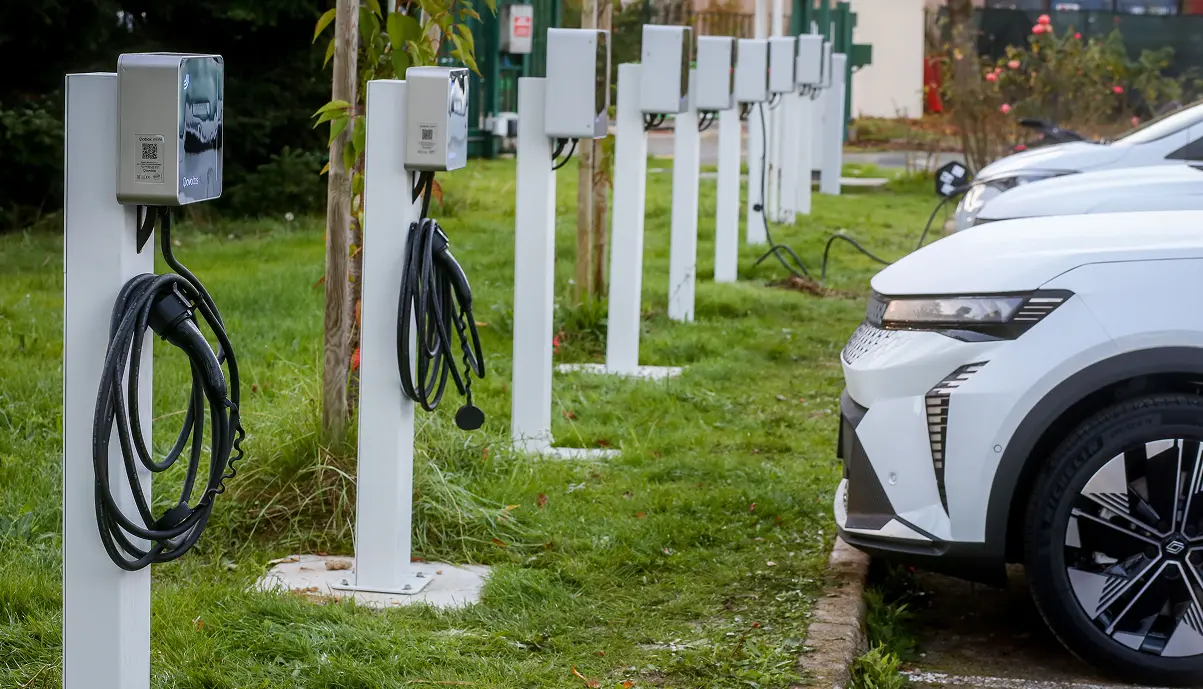
The LOM Law mandate applies to non-residential buildings with parking facilities, regardless of the business sector, including offices, hotels, restaurants, retail stores, healthcare facilities, warehouses, and industrial parking lots.
For existing buildings (building permits filed before March 11, 2021): the threshold is set at more than 20 parking spaces (a parking lot with 20 spaces or fewer is not subject to the LOM law). This requirement came into effect on January 1, 2025, and applies to non-residential buildings owned or occupied by companies that do not meet the European definition of an SME, which in practice means companies employing 250 employees or more or exceeding the financial thresholds defined by European regulations.
For a new building or one undergoing major renovation (building permit filed on or after March 11, 2021): the threshold drops to 10 spaces. A renovation is considered major when its cost represents at least 25% of the building's value, excluding land.
Which cases qualify for an exemption?
- SME owner-occupier (art. L113-14 2° of the CCH) : total exemption if the building is owned and occupied by an SME under the European definition (fewer than 250 employees and turnover < €50M or balance sheet < €43M)
- Installation cost exceeding 7% of the renovation cost (art. L113-14 1°) : if the cost of the charging stations exceeds this threshold during major works, the obligation is waived
- Main switchboard (TGBT) work more expensive than downstream work (Art. L113-13 para. 2): if the electrical reinforcement upstream of the main low-voltage switchboard costs more than installing the charging points, the number of mandatory charging stations is reduced until the cost of upstream work no longer exceeds that of downstream work
What are the exact requirements (charging stations + pre-equipment)?
Existing buildings (building permit filed before March 11, 2021)
⚠️ Accessible to disabled persons ≠ reserved for disabled persons : a accessible charging station meets accessibility standards (connector height, maneuvering space) but remains open to any driver. A reserved station is accompanied by a parking space exclusively dedicated to people with reduced mobility. This distinction is important: reserved stations are only mandatory for parking lots with 200 or more spaces.
Example: a 60-space parking lot must have at least 3 charging points, including at least one accessible to people with reduced mobility, in accordance with the rule of one mandatory station plus one additional station for every 20 spaces beyond the regulatory threshold.
New or renovated buildings (building permit filed after March 11, 2021)
*Pre-equipment covers conduits, cable trays, and electrical sizing to allow for the future power supply of spaces without installed charging stations. The goal is to plan ahead without having to redo the screed.
Horizon 2027: Stricter requirements
The European AFIR regulation (Alternative Fuels Infrastructure Regulation) is progressively accelerating the deployment of charging infrastructure across the European Union. It sets specific requirements for publicly accessible networks, as well as obligations for buildings and parking lots. Implementation details continue to evolve and must be factored into medium-term compliance projects.
Penalties for non-compliance
There is currently no specific administrative fine codified solely for the lack of a charging station in an existing parking lot. However, this does not mean there is no risk.
TheArticle L183-4 of the Construction and Housing Code (CCH) provides for a fine of up to €45,000 for failure to comply with certain construction obligations, particularly those regarding pre-equipping and electric vehicle charging infrastructure as set out in Articles L. 113-11 to L. 113-15. Violations may be identified during inspections conducted under the CCH and may lead to criminal prosecution where applicable.
In 2026, inspections of publicly accessible EV charging stations will be stepped up under the European AFIR regulation (information, payment, and data accessibility).
Beyond regulatory compliance, a well-sized installation also allows companies to optimize tax incentives and subsidies for corporate charging station installations, subject to the specific conditions of each program. To learn more about these levers, read our article on the cost of installing a charging station for businesses.
How can you achieve compliance quickly?
Step 1: Conduct an electrical audit
Check the number of spaces and the power available at the main low-voltage switchboard (MLVS). If an Enedis power upgrade is required, allow an additional 2 to 6 months; this is the most common limiting factor in EV charging infrastructure projects.
Step 2: Size the installation
For a corporate parking lot, a 7 kW to 22 kW AC charging station covers almost all needs: a vehicle parked for 8 hours will generally leave with a full charge. The number of stations depends on the usage profile (company fleet, employees, visitors) and the projected growth of the electric vehicle fleet.
Step 3: Choose an EV-certified installer
The installation of a charging station must be carried out by an EV-certified professional (Qualifelec, AFNOR Certification or Qualit'EnR) whenever required by regulations. This certification is also an essential condition for accessing certain financial subsidies and ensuring a compliant installation.
Step 4: Monitor and optimize
An unsupervised charging station leads to hidden costs and undetected downtime. Integrating remote management, user billing, and consumption tracking from the start turns your infrastructure into a sustainable operational asset.
For a complete overview of available solutions, read our article on corporate charging stations.
The Qovoltis solution for your compliance needs
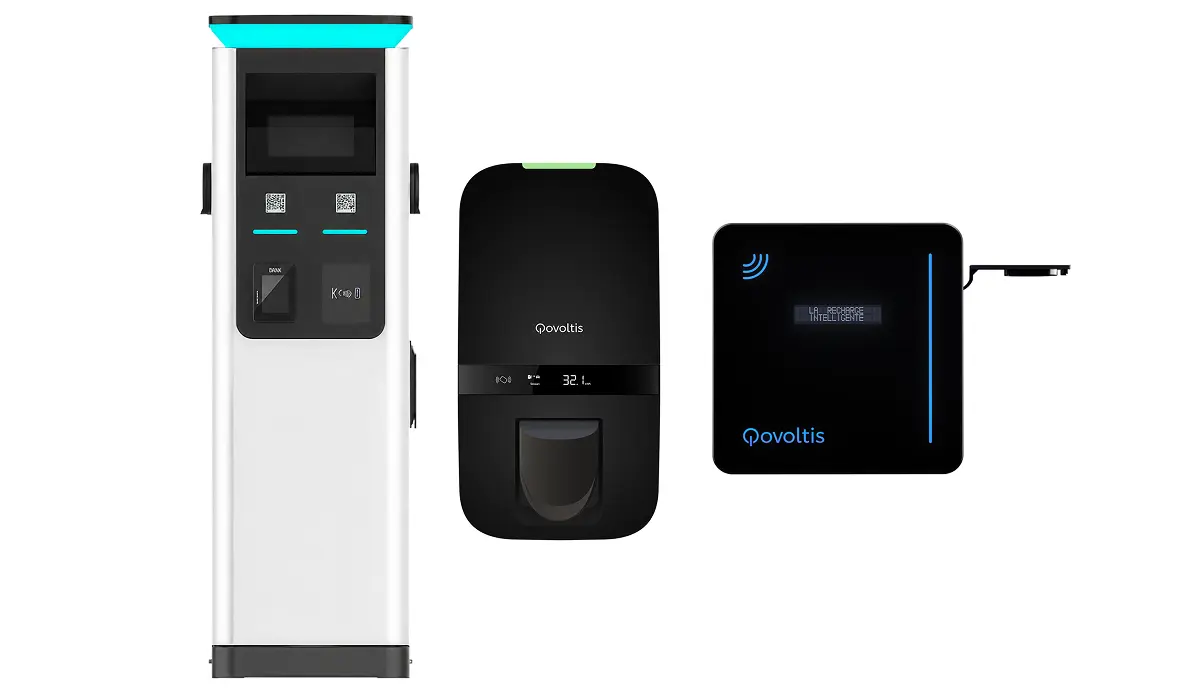
Qovoltis supports businesses from start to finish: LOM compliance audits, sizing, installation, and monitoring via Qockpit, our real-time charging station management platform.
Our Qobox P chargers (7.4 kW or 22 kW, MID-certified, 7-year warranty, 100% European-made) and Qobox mini (up to 22 kW, Wi-Fi/Ethernet/PLC, Linky-compatible) are designed to fit any parking layout. For high-traffic areas, the Qobox E offers dual simultaneous charging and integrated payment options (RFID badge, QR code, credit card terminal).
On-site charging is the perfect complement to home charging : employees who charge at home overnight and top up during the day at the office never run out of power, and the company reduces the strain on its parking chargers. Qovoltis also supports the installation of residential charging stations for employees, providing a truly comprehensive electric mobility solution. Check out our article on home charging stations for employees.
FAQ
In what cases is my company not required to install charging stations?
The LOM law provides three exemptions for existing buildings:
- SME owner-occupiers : if your company has fewer than 250 employees and both owns and occupies the building, you are fully exempt.
- Disproportionate cost : if the cost of the charging stations exceeds 7% of the total renovation cost during major works, the obligation is waived.
- Electrical upgrades : if upgrading the main distribution board costs more than the charging stations themselves, the required number is reduced. These exemptions do not apply to new or heavily renovated buildings (10-space threshold).
What is the difference between pre-equipping and installing a charging station?
Pre-equipping involves the technical preparation of the parking area: conduits, cable trays, and appropriately sized power supply. No charging station is installed at this stage. When done during construction or renovation, it is much cheaper than retrofitting later. The charging station can be added later upon request.
Should I equip only my parking lot or also my employees' homes?
There is no obligation to install charging stations at employees' homes. However, it remains the most effective strategy. An employee who charges at home overnight (6 to 8 hours is enough for a full charge) and tops up during the day at the office covers 100% of their needs without ever running out of power. For the company, this reduces pressure on the parking lot: fewer chargers reaching capacity and fewer usage conflicts. Qovoltis also supports the installation of residential charging stations for employees, from home to office.
Key takeaways
The LOM law provides a stable framework with clear thresholds. If your company has more than 250 employees and a parking lot with over 20 spaces, you have been subject to this requirement since January 1, 2025. For new or renovated buildings, the threshold drops to 10 spaces, regardless of company size. The timeline is tightening with the 2027 AFIR requirements: it is better to act now than to be forced by regulation later.
The ideal strategy is to combine overnight home charging with daytime office charging. Employees never run out of power, and the company optimizes its charging station usage.
Learn more
- Corporate charging stations: 2026 obligations, costs, and solutions
- The complete 2026 guide to the cost of installing corporate charging stations
- Charging stations at employee homes
- Qovoltis - Hospitality
Sources and references
- Law no. 2019-1428 of December 24, 2019, on Mobility Orientation - Article 64 (Légifrance)
- Articles L113-11 to L113-17 of the Construction and Housing Code (Légifrance)
- Decree no. 2021-546 of May 4, 2021 (Légifrance)
- Qualifelec - IRVE qualification
- Qualit-EnR Recharge Elec +
- AFNOR Certification - IRVE qualification
- European AFIR Regulation
Article written in August 2026. Information verified as of the date of publication. This article is provided for informational purposes only and does not constitute legal advice.