Updated on October 22, 2026
The number of charging stations a fleet needs depends on the vehicles on site each day, the distance they drive and home charging, not on the size of the fleet. There is no official ratio, and every provider uses its own calculation. For a fleet manager or CFO, the stakes are twofold: an oversized installation ties up budget, while an undersized one leaves vehicles stranded and means reopening the works. Here is a transparent calculation method, with its assumptions and a worked example. For an overview of the topic, see our complete guide to workplace charging stations.
Do you need one charging station per fleet vehicle?
Not always: one charging point per vehicle is only needed for high-mileage drivers and vans charged overnight at the depot. For other profiles, it oversizes the investment. A vehicle driving 40 km a day uses about 7 kWh, so a 30 kWh charge covers about 4 days of driving. Each day, only part of the fleet needs to be plugged in.
The still-common "1 vehicle = 1 charger" idea overlooks the fact that most fleet vehicles do not drain their battery in a single day.
One charging point charges one vehicle per day
A vehicle parked at the office stays in its space all day. Even if charging finishes in 2 hours, nobody leaves a meeting to free up the charger for a colleague. In practice, one charging point therefore serves only one vehicle per day. This rule is what turns an energy requirement into a number of charging points.
Charging points or charging stations: what is the difference?
The calculation is based on charging points, not charging stations. A dual charging station counts as 2 charging points, since it charges two vehicles at the same time.
How do you calculate the number of charging stations for a company fleet?
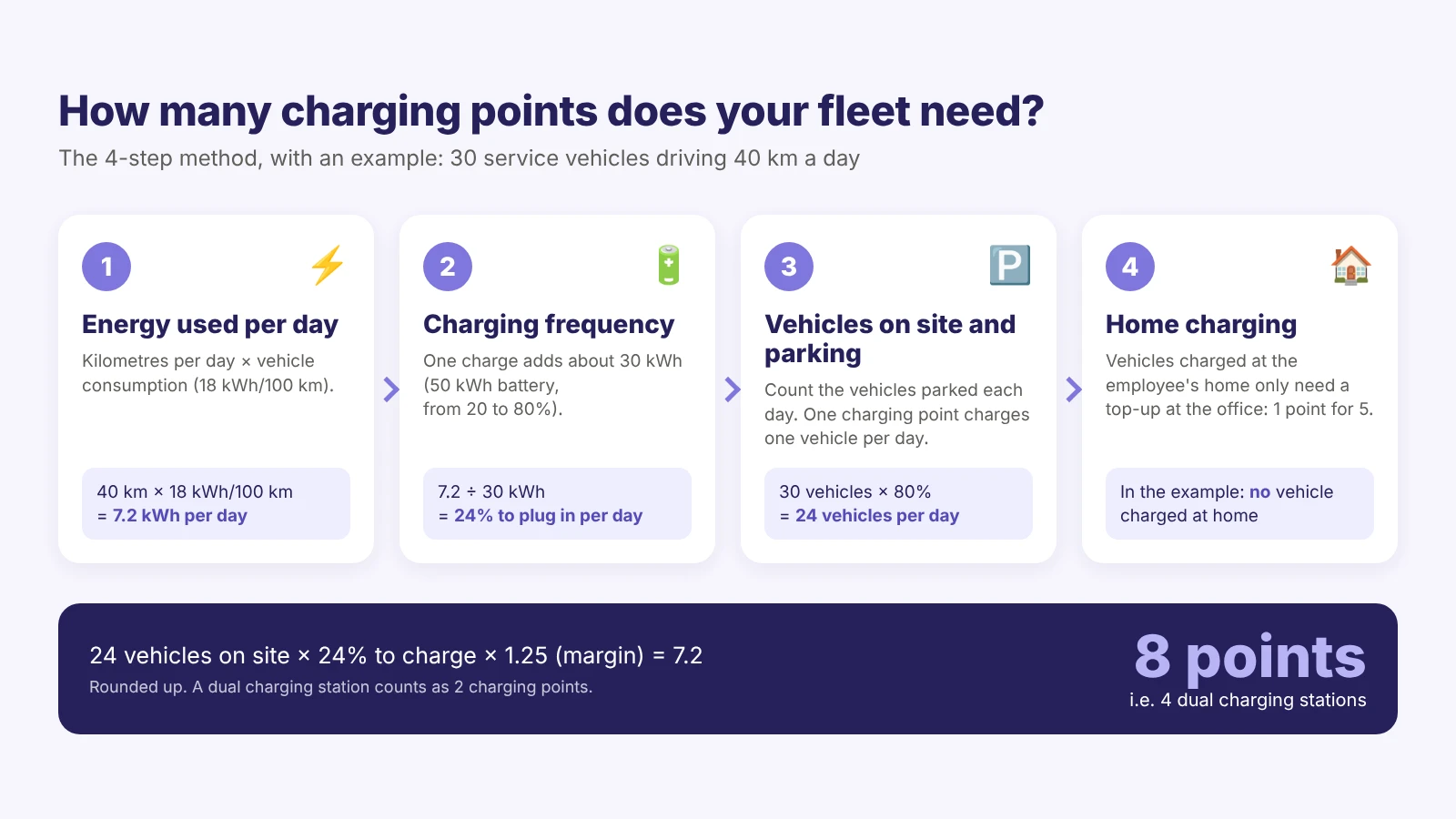
The number of charging points a fleet needs is calculated with a simple formula: vehicles on site per day × share needing a charge that day × 1.25, rounded up. The share needing a charge depends on the energy used each day; the 1.25 factor adds a 25% margin for the unexpected (a longer round, a vehicle arriving almost empty).
First rule: count the electric vehicles on site on an average day, not the size of the fleet. Holidays, remote work and multi-day trips always reduce the number of vehicles parked on site.
The method is based on the following assumptions:
- a 50 kWh battery charged from 20 to 80%, i.e. 30 kWh added per charge;
- consumption of 18 kWh/100 km, within the 12 to 24 kWh/100 km range reported by ADEME depending on the model;
- a 25% margin, for a deliberately "upper-mid" result.
Worked example: a company has 30 service vehicles driving 40 km a day, with 24 parked on site on an average day. 40 km × 18 kWh/100 km = 7.2 kWh, i.e. 24% of a 30 kWh charge. 24 × 7.2/30 × 1.25 = 7.2, rounded up to 8 charging points, i.e. 4 dual charging stations.
To run this calculation with your own figures, you can estimate how many charging stations your fleet needs with our calculator. A full example, for a 120-space car park, is detailed below in the section on legal requirements.
How many kWh does a fleet vehicle use per day?
An electric vehicle uses 12 to 24 kWh/100 km depending on the model, according to ADEME (the French Agency for Ecological Transition). At the value used here, 18 kWh/100 km, 40 km a day represents about 7 kWh and 60 km about 11 kWh.
Which charging power should you choose based on parking time?
For a vehicle parked all day, a 7.4 or 11 kW alternating current (AC) charging station is enough: at 7.4 kW, it adds 30 kWh in about 4 hours, far less than a working day. Direct current (DC) fast chargers are only useful for very short turnarounds, such as deliveries or shift teams. To compare use cases, see how to choose between a 7 kW and a 22 kW charging station.
How many charging points do you need for each fleet profile?
For the most common profile (service vehicles driving 50 to 80 km a day), the benchmark is on average 1 charging point for every 2 vehicles on site; 1 for 3 below that, and 1 per vehicle for high-mileage drivers and depot vans. This benchmark is a worked example based on the assumptions above, not an official standard.
Assumptions: 50 kWh battery charged from 20 to 80% (30 kWh), 18 kWh/100 km, 25% margin, rounded up.
If vehicles take turns in the same space (two shifts of 4 hours or more), one charging point serves 2 vehicles per day: divide the result by 2 and use chargers of at least 11 kW.
The last row needs some explanation. With the median home-to-work commute, 7.8 km one way according to Insee, the calculation would give 1 point for 8 vehicles. The benchmark uses 1 point for 4 to cover employees with long commutes or no charger at home.
How many charging stations does the law require in your company car park?
Since January 1, 2025, a car park with more than 20 spaces attached to an existing non-residential building must have at least 1 charging point accessible to people with reduced mobility, plus 1 point for every additional 20 spaces, i.e. 6 points for 120 spaces (article L113-13 of the French Construction and Housing Code). This minimum applies to the whole car park, whatever its use: it is a legal floor, not your fleet's real need. Cases and exemptions are detailed in our article on legal requirements for company car parks.
Your calculation must always reach this minimum if your car park is covered; in practice, the real need quickly exceeds it.
Illustrative figures. The number of electric vehicles in 3 years is an assumption of the example, not market data.
The law requires 6 charging points. The real need is 10 points today and 18 in 3 years. Installing 18 points from the start, or 10 points with 8 pre-equipped spaces (conduits, electrical panel), avoids reopening the works in a year or two.
What are the requirements for new or renovated buildings?
For building permits filed since March 11, 2021, 20% of the spaces in a non-residential car park with more than 10 spaces, whether new or undergoing major renovation, must be pre-equipped (conduits and reserved power), and at least 1 space must have a charging point accessible to people with reduced mobility (2 above 200 spaces) (article L113-12 of the French Construction and Housing Code; AVERE-France legal FAQ).
How many years ahead should you size your fleet's charging stations?
Size for the number of electric vehicles expected on site in 3 years, and pre-equip conduits and the electrical panel for the next phase. For companies with 100 or more light vehicles, the target share of low-emission vehicles among those added to the fleet over the last three years rises from 18% in 2026 to 48% in 2030 (article L421-132-4 of the CIBS, the French tax code on goods and services).
These targets fall under the annual incentive tax, in force since March 1, 2025, which replaces the former LOM law quotas (20%, 40%, 70%). Annual targets set by article L421-132-4 of the CIBS:
- 18% in 2026;
- 25% in 2027;
- 30% in 2028;
- 35% in 2029;
- 48% in 2030.
If the target is not met, the tax is calculated from a rate of €4,000 in 2026, then €5,000 from 2027, applied to the gap with the target (articles L421-132-2 and L421-132-3 of the CIBS).
Smaller companies are not subject to this tax, but the market is moving for them too: electric cars accounted for 41.9% of new passenger car registrations in September 2026, with volumes up 106.7% year on year (AVERE-France barometer, September 2026).
Does charging at employees' homes reduce the number of charging stations needed at the office?
Yes: equipping the homes of employees who have a company car directly reduces the number of charging stations to install at the office. Charged at home, these vehicles rely less on the site's charging points, which remain available for service vehicles.
At the office, they only need an occasional top-up for a busier day than planned: the benchmark drops to 1 charging point for every 5 vehicles on site, compared with 1 for 2 for a service vehicle. In the 120-space example, the 10 electric company cars expected in 3 years only require 2 charging points in the car park.
Qovoltis installs charging stations at the homes of employees who live in a detached house and have a parking space. Equip your employees: charging stations at the office and at home.

How is home charging of a company car billed?
The charging station installed at home measures every charging session. The management platform tracks business and personal use and feeds employees' business charging into their expense reports.
How can you charge more vehicles without increasing your meter's power?
Smart charging lets you charge more vehicles without increasing your subscribed power. The system shares the available power between plugged-in vehicles in real time and reduces each charger's power when the building uses more. This prevents power overruns and outages.
Without load management, 10 chargers of 22 kW can draw 220 kW at the same time. Yet above 36 kVA, the grid connection moves to a different category (low voltage above 36 kVA, under the Enedis connection price schedule) and costs more. Dynamic load management avoids this jump in power and makes it possible to add the next phase's charging points. See also how smart charging works.
How can you track consumption and access by driver?
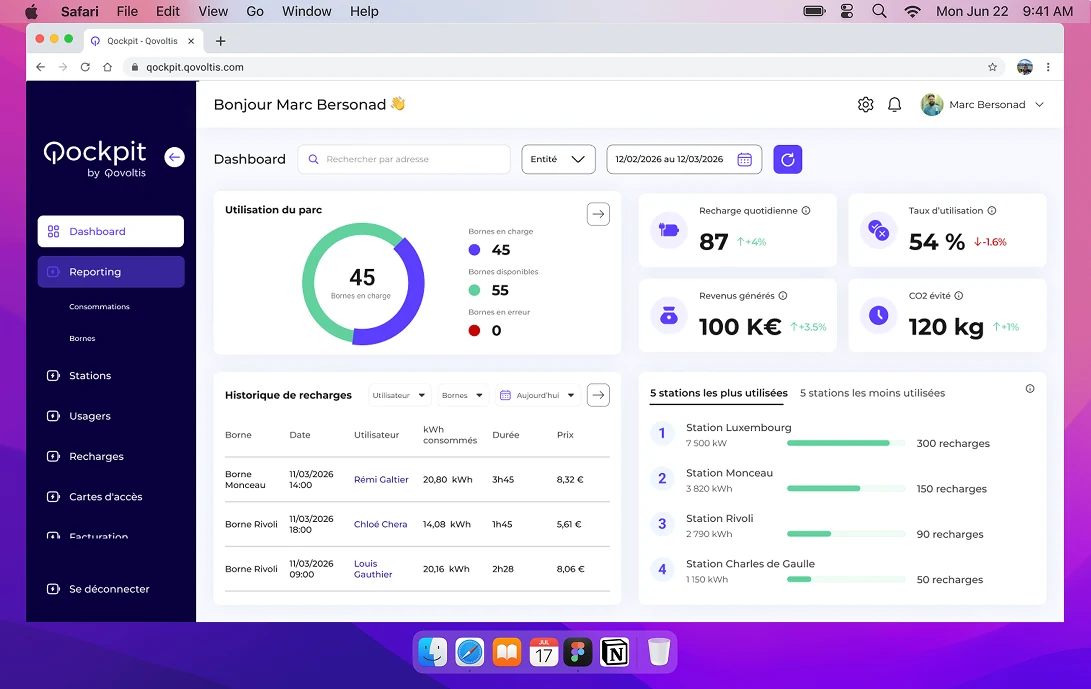
Each driver has an individual badge. The charging station management platform centralizes consumption by driver, manages access rights and automates charging billing, at the office and at home. The fleet manager can see which drivers charge, where and how much, and adjust the number of charging points based on actual use.
FAQ
Is there a grant for installing charging stations for a company fleet?
No, not for light vehicles. The ADVENIR programme has no longer funded charging stations for company fleets and employees since January 1, 2023. It still funds other projects, such as charging for heavy goods vehicles and charging stations in shared residential buildings.
How much does a charging station for a company fleet cost?
The cost depends on the type of charging station, its power, the connection work and the number of charging points installed at once. Price ranges and cost items are detailed in our article on the cost of installing a charging station at work.
Can employees charge their personal car at company charging stations?
Yes. Charging a personal vehicle at a workplace charging station is a benefit in kind valued at zero, electricity included, between January 1, 2023 and December 31, 2027 (article 4 of the order of February 25, 2025). The company sets the access rules by badge. Find out more in our article on benefits in kind and EV charging.
Who can install a charging station at a company?
A professional holding an IRVE qualification (electric vehicle charging infrastructure). Except for installations of 3.7 kW or less in a private home, every charging station must be installed by a qualified professional (article D353-2 of the French Energy Code).
Key takeaways
- Number of charging points = vehicles on site per day × share needing a charge × 1.25, rounded up.
- One charging point charges one vehicle per day; a dual charging station counts as 2 points.
- For service vehicles driving 50 to 80 km a day, plan on average 1 charging point for every 2 vehicles on site; 1 per vehicle only for high-mileage drivers and depot vans.
- The legal minimum (1 point per 20 spaces, article L113-13 of the French Construction and Housing Code) is a floor, not the real need.
- Size for the fleet expected in 3 years, equip the homes of employees who can, and manage power with smart charging.
Further reading
- Legal requirements for company car parks
- Smart charging: how it works
- 7 kW or 22 kW charging station: which one to choose?
- Benefit in kind: electric car and charging station
Sources and references
- French tax code on goods and services (CIBS), articles L421-132-3 and L421-132-4: annual incentive tax, targets and rates
- French Construction and Housing Code, article L113-13: charging points in car parks of existing non-residential buildings
- French Construction and Housing Code, article L113-12: new non-residential buildings or buildings undergoing major renovation
- Order of February 25, 2025 on benefits in kind, article 4: charging at the workplace
- French Senate, written question no. 10164, answer of April 25, 2024
- ADVENIR, end of funding for fleet charging stations
- ADEME, battery, range, price: the real advantages of electric cars (2026)
- Insee Première no. 1948, home-to-work commutes
- AVERE-France / Colombus barometer, September 2026
- AVERE-France, legal FAQ on fleet electrification (2025)
- Enedis, practical guide to charging your electric car
- French Energy Code, article D353-2: qualification of charging station installers
- CRE, deliberation 2025-100, Enedis connection price schedule
Article written in October 2026. Information checked at the date of publication; car park regulations (article L113-13 of the French Construction and Housing Code) and fleet taxation (articles L421-132-3 and L421-132-4 of the CIBS) change every year. The calculation benchmark presented here is an example based on stated assumptions, not an official standard. This article is for information only and does not constitute legal or tax advice.