Updated on 08/27/2026
In 2026, fleet electrification is no longer a forward-looking concept: it is an operational decision being made every week by fleet managers, HR directors, and CFOs. The reasons are numerous: fuel cost reduction, low-emission zones, CSR commitments, tax advantages… yet implementation remains complex. Where do you start? How do you manage charging for dozens or hundreds of drivers? This guide provides a clear, step-by-step method.
Why electrify your fleet in 2026?
A significantly more favorable TCO
The total cost of ownership (TCO) of an electric vehicle is often higher than that of a combustion engine vehicle at purchase, but it quickly flips during use. Three areas make the difference:
- Energy : charging an electric vehicle costs 2 to 3 times less per kilometer than a full tank of diesel or gasoline for daily use.
- Maintenance : no oil changes, no clutch, and less brake wear (regenerative braking). The maintenance cost of an electric vehicle is estimated to be 30 to 40% lower over 4 years compared to a combustion engine vehicle.
- Taxation : 100% VAT recovery on electricity for businesses, a 70% regulatory deduction (capped at €4,641.60 per year in 2026) for 100% electric vehicles made available since February 1, 2025, and until December 31, 2027 (as part of the flat-rate assessment). As well as super-depreciation applicable to certain categories of eligible vehicles.
Accelerating regulatory constraints
Low-Emission Zones (LEZs) are tightening in major French urban areas. Paris, Lyon, Marseille, and several other metropolitan areas are gradually restricting access to combustion engine vehicles in city centers. For a fleet that regularly operates in urban areas, anticipating this constraint is essential to avoid short-term operational restrictions.
The requirements for installing charging stations in businesses have also applied to many non-residential parking lots since January 1, 2025.
Step 1: Audit your current fleet
Before making any decisions, you need to know exactly how your fleet is currently performing. The audit covers four key areas:
Vehicle usage : average daily mileage per vehicle, type of route (urban, suburban, highway), and driver profile (field sales, office-based, management). This is the most critical data for the next steps.
Fuel consumption : reviewing 12 months of invoices provides a solid baseline for projecting potential savings after electrification.
Charging access : how many drivers live in detached houses (where home charging is possible)? How many live in apartments without dedicated parking? Can charging stations be installed in the company parking lot?
Current contracts : remaining terms on long-term leases or financing agreements, and vehicles due for renewal in the next 12 to 24 months; these are the natural first candidates for electrification.
Step 2: Identify priority use cases for electrification
Electrifying an entire fleet all at once is rarely practical, either technically or financially. The best approach is to identify the vehicles whose usage patterns are a perfect match for electric power and start with them.
Ideal use cases for electric vehicles:
- Vehicles covering less than 250 km per day in regular use
- Routes that are primarily urban and suburban
- Vehicles returning to base every evening : overnight on-site or home charging available
- Inside sales staff, field technicians, executive vehicles…
- Captive fleets : local delivery, after-sales service, internal mail
Use cases less suited for the short term:
- High-mileage sales staff regularly exceeding 400 km per day
- Vehicles operating in very rural areas, far from any public charging network
- Vehicles used in 24/7 rotation with no available charging window
This segmentation often allows for the electrification of 40 to 60% of a fleet in the first wave, where the return on investment is fastest.
Step 3: Deploy charging infrastructure
Once priority use cases have been identified, physical deployment can begin.
On-site
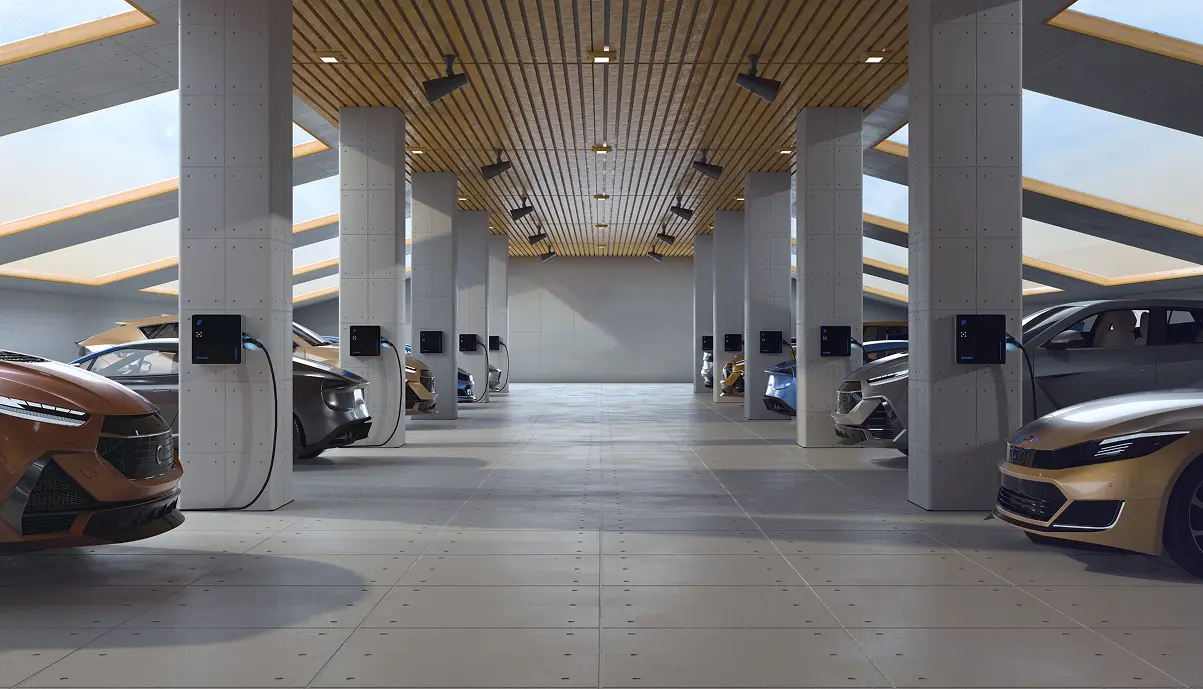
The infrastructure depends on the number of vehicles to be charged simultaneously, the power available at the main low-voltage switchboard (MLVS), and the usage profile. For a fleet charging overnight, a 7 kW AC charging station is sufficient in most cases: a vehicle parked for 8 to 10 hours will be fully charged. The 22 kW option is relevant for vehicles that are only on-site for 3 to 4 hours, or to anticipate growing needs.
To estimate your budget, check out our guide on the cost of installing a charging station for businesses.
At employees' homes
Installing residential charging stations for company car drivers ensures secure daily charging and eliminates reimbursement disputes. It requires the employee's consent and, in condominiums, compliance with the right to plug (LOM law). For more details, see our article dedicated to home charging for employees.
Timelines and qualifications
The installation must be carried out by an EVSE-qualified technician (Qualifelec, AFNOR Certification or Qualit'EnR). Allow 8 to 10 weeks for installation on an existing meter, and up to 18 weeks if a new Enedis connection point needs to be created. For a complete overview of the available solutions and equipment, consult our guide to workplace charging stations.
Step 4: Managing and billing for charging
This is often the most underestimated aspect of fleet electrification. Vehicles are charged in three different contexts, each with its own billing rules.
On-site charging
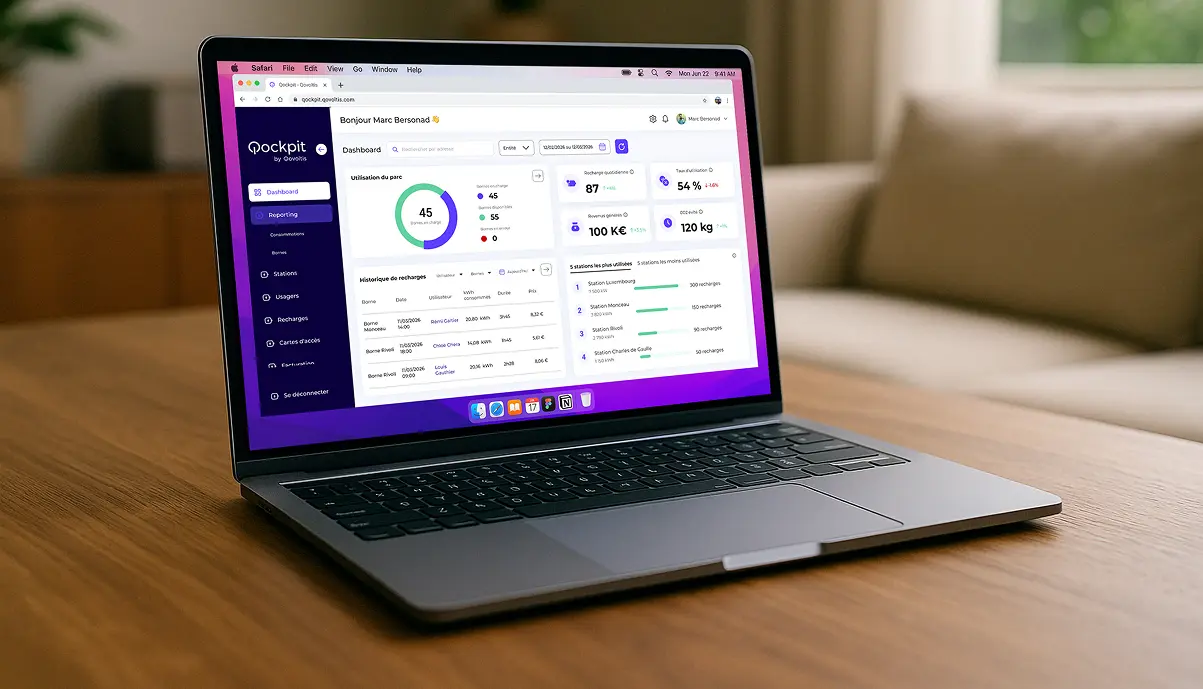
Charging stations installed in the parking lot are the easiest to oversee. Management software like Qockpit allows you to identify who is charging, how much, at what cost, and to allocate expenses by cost center, vehicle, or user.
Charging at employees' homes
When a driver charges their company vehicle at home, the company must reimburse these energy costs. Two approaches exist:
- Personal badge : the company installs a residential charging station with a personalized badge. Consumption is tracked precisely and reimbursed based on actual usage.
- Electric mileage allowance (IKE) : flat-rate reimbursement based on the URSSAF scale. Simple to administer, but less precise.
Qovoltis supports theinstallation of residential charging stations for employees, with centralized monitoring via Qockpit.
Public charging (public networks)
For long-distance travel, drivers charge on public networks: Ionity, Electra, TotalEnergies Charge, Engie Izivia, Qovoltis, and many others. Without a dedicated tool, management quickly becomes complex: expense reports, variable rates, and multiple networks.
The solution: a multi-network card or badge that centralizes charging across all public networks into a single invoice, by driver or by vehicle, with no manual expense reports. The long-term goal is to have a single interface to consolidate charging costs across site, home, and public locations.
The Qovoltis solution for electrifying your fleet
Qovoltis supports companies from the initial audit to daily supervision: fleet analysis, installation of charging stations on-site and at employees' homes, and management via Qockpit : a centralized dashboard to track consumption, costs, and equipment status in real time.
Our Qobox P charging stations (7.4 kW or 22 kW, MID-certified, 7-year warranty, 100% European-made) and Qobox mini (up to 22 kW, Wi-Fi/Ethernet/Powerline, Linky compatible) adapt to all fleet profiles.
FAQ
What are the benefits and financial incentives for electrifying your fleet in 2026?
The main ones are: super-depreciation (additional tax deduction on the purchase of professional EVs), 100% recoverable VAT on electricity for company vehicles, and the70% reduced benefit-in-kind for EVs provided to employees (extended until the end of 2027). Some regions also offer co-financing for sustainable mobility projects. Note: the ADVENIR program for fleets and employees has been discontinued as of January 2026.
How does home charging reimbursement work?
Two methods exist: reimbursement via theelectric mileage allowance (IKE) based on the URSSAF scale, or the installation of a residential charging station with a personal badge allowing for precise tracking of consumption, which is then reimbursed at actual cost. The second option is more transparent for the company and more convenient for the driver in the long run.
Is DC fast charging necessary for a company fleet?
In the vast majority of cases, no. DC fast charging is expensive to install and is only relevant for occasional on-the-go charging. For daily fleet charging, a 7 to 22 kW AC station is more than sufficient: a vehicle charged for 4 to 6 hours will have a range of 200 to 400 km, depending on the model.
How do you manage public charging for a geographically dispersed fleet?
The most effective solution is a multi-network card or badge that consolidates charging across all public networks into a single invoice per driver or vehicle, eliminating manual expense reports. Paired with Qockpit for on-site and home charging, you gain complete visibility over all your energy costs.
Key takeaways
Electrifying your fleet in 2026 is a gradual and profitable process, provided you start with the right use cases. An audit is an essential first step; it often reveals that 40% to 60% of vehicles are excellent candidates for the first wave. Charging is the true success factor: on-site, home, and public charging must be managed in a unified way to control costs and ensure driver satisfaction.
Learn more
- Corporate charging stations: requirements, costs, and 2026 solutions
- Corporate charging station requirements: what the LOM law says
- Charging stations at employees' homes
- Cost of installing a corporate charging station
Sources and references
- Law no. 2019-1428 of December 24, 2019, on Mobility Orientation (Légifrance)
- Electric vehicle benefit in kind — URSSAF
- Low Emission Zones (ZFE-m) — Ministry of Ecological Transition
- AFNOR Certification — IRVE qualification
- Qualifelec — IRVE qualification
- BOSS — Benefits in kind
Article written in August 2026. Information verified as of the date of publication. This article is provided for informational purposes only and does not constitute legal advice.