Updated 07/30/2026
Introduction
Deploying multiple charging stations in a company parking lot quickly raises a question: how can you avoid overloading the electrical system? This is exactly the problem that smart chargingsolves. It refers to a charging station's ability to adjust its power output in real time to optimize the site's overall electricity consumption. This guide explains what it is, how it works in practice, and why it has become essential for any electric fleet in 2026.
What is smart charging?
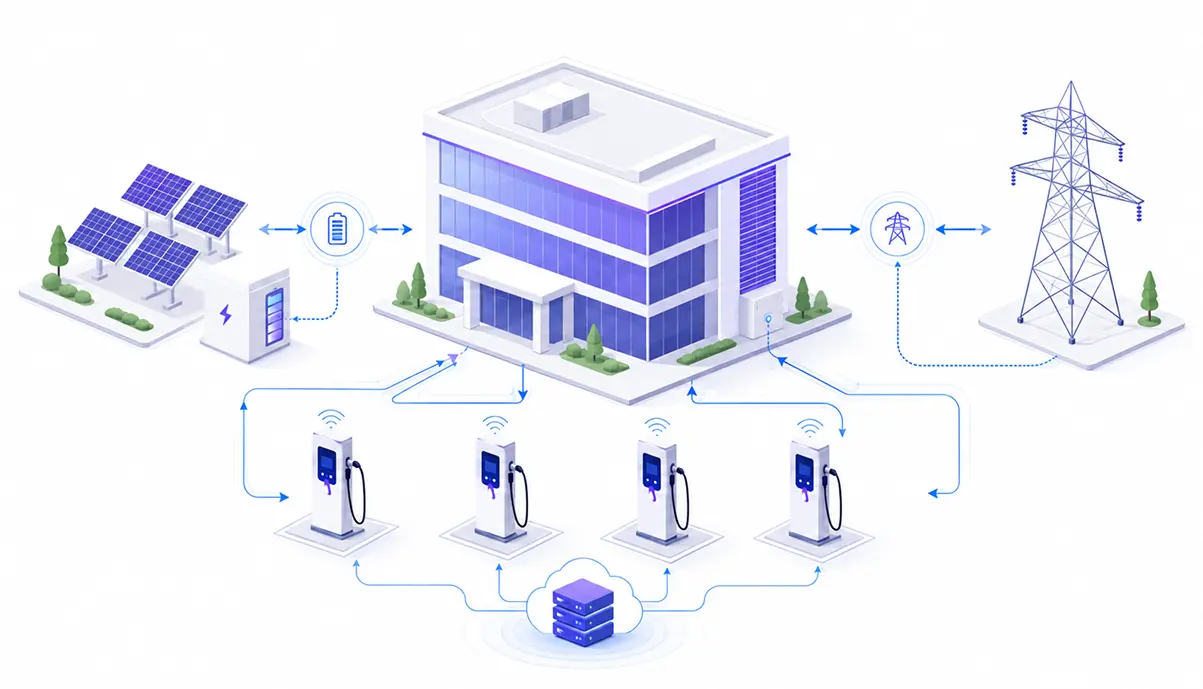
Smart charging is the ability of a charging station to dynamically modulate its power output based on real-time electrical constraints: building consumption, subscribed power capacity, number of vehicles plugged in, and current electricity rates.
A standard charging station works on an all-or-nothing basis: once plugged in, it draws its maximum power. A smart charging station, however, constantly "listens" to what is happening on the site's electrical network and adjusts its charging accordingly. The result: multiple vehicles charge simultaneously without ever exceeding the subscribed power capacity and without any human intervention.
Smart charging relies on the OCPP (Open Charge Point Protocol), an international standard that allows the charging station to communicate with a management system (backend). At Qovoltis, this system is called Qockpit.
How does it work?
Smart charging relies on three complementary mechanisms.
- Dynamic load balancing
This is the core of smart charging. The system measures the power available on-site in real time (subscribed power minus the building's current consumption) and then intelligently distributes it among all active charging stations. If the building's consumption increases (e.g., a machine starts up or air conditioning peaks), the system automatically reduces the power allocated to the stations. When consumption drops, it reallocates that power to the vehicles.
- Off-peak scheduling
Smart charging can be configured to prioritize charging during off-peak hours. Sessions start automatically when the cost per kWh is lowest, without the user needing to think about it.
- Charging prioritization
A vehicle leaving in 2 hours is prioritized over one that will remain plugged in all night. Prioritization rules are configurable based on departure time, user profile, or battery level. When charging at home, the station synchronizes with the household's smart meter to adjust in real time.
The benefits of smart charging and when to use it
Avoid increasing your subscribed power
Without smart charging, each station adds its nominal power to the site's total demand. In a parking lot with ten 22 kW stations, this would mean an additional 220 kW to contract—a long and costly process with the grid operator. With load balancing, the same electrical infrastructure can power 10, 20, or even 30 stations by intelligently sharing the available capacity.
Reduce charging costs
By shifting charging to off-peak hours, smart charging reduces the average cost per kWh consumed.
When should you use it?
Smart charging is relevant as soon as multiple stations coexist on the same site or when charging needs to adapt to electrical or pricing constraints.
- Corporate parking with multiple stations : load balancing prevents overloads and maximizes the number of vehicles charged simultaneously.
- Employee homes connected to the Linky meter, smart charging adjusts charging to the household's consumption and schedules sessions during off-peak hours.
- Fleet with departure constraints : vehicles are prioritized based on their departure time, ensuring that every driver finds their vehicle charged exactly when they need it.
The Qovoltis solution
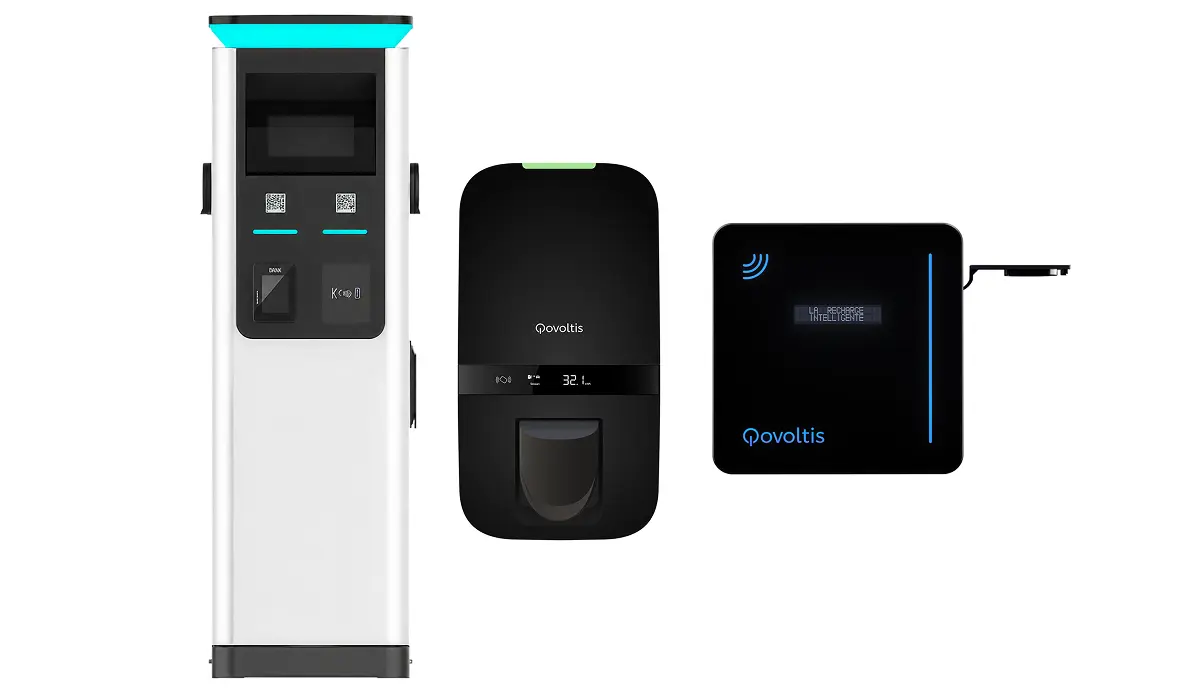
All Qovoltis charging stations feature native smart charging.
The Qobox mini (up to 22 kW, wall-mounted) includes smart charging with Linky compatibility, making it ideal for employees' homes.
The Qobox P (7.4 kW or 22 kW) features dynamic load balancing, either wired (via current transformers) or networked (RS-485, Ethernet), for demanding professional installations.
The Qobox E (2×7.4 kW or 2×22 kW), a dual-socket pedestal charging station, integrates Dynamic Load Balancing (DLB) (Dynamic Load Balancing – DLB ) for high-turnover semi-public parking lots.
Everything is managed via Qockpit, the Qovoltis supervision platform: configure charging rules, monitor all stations in real time (on-site and at home), automate billing, and generate consumption reports. Qockpit provides a centralized view regardless of the number of sites or equipped employees.
FAQ
Are all charging stations compatible with smart charging?
No. Smart charging requires a connected station and a management system (OCPP backend). A non-connected station cannot adjust its power output in real time. All Qovoltis stations (Qobox mini, Qobox P, Qobox E) include this feature natively.
Does smart charging slow down the charging process?
Not necessarily. A single vehicle plugged in will charge at maximum power. It is only when multiple vehicles are plugged in simultaneously, or when the building has high energy demand, that the power per station is adjusted seamlessly for the user.
Is a subscription required to use smart charging?
With Qovoltis, smart charging is included in the solution: Qobox stations have it built-in, and Qockpit allows you to configure and monitor it from a web or mobile interface.
Does smart charging work at employees' homes?
Yes, it is actually one of its most effective use cases. Connected to the Linky meter, the Qobox mini adjusts charging power to the household's consumption in real time and schedules sessions during off-peak hours. Reimbursement at actual cost is calculated automatically for every session.
Key takeaways
Smart charging is not just a feature; it is essential for deploying multiple stations at a single site without exceeding your subscribed power capacity or driving up costs. It adapts charging to the building's actual electrical load, schedules sessions during the most cost-effective hours, and prioritizes vehicles based on operational needs. With Qovoltis stations and Qockpit, this management is native and centralized, whether on-site or at employees' homes.
Learn more
- Cost of installing a commercial charging station: 2026 complete guide
- 7 kW vs. 22 kW charging stations: what is the difference and which one should you choose?
- Charging stations at employees' homes: 2026 installation and tax guide
- Qovoltis business solutions
Sources and references
- OCPP - Open Charge Point Protocol
- Qockpit - Qovoltis monitoring tool
- Qovoltis - Qobox mini
- Qovoltis - Qobox P
- Qovoltis - Qobox E (coming soon)