Updated 07/09/2026
Introduction
According to the 5th Avere-France biannual barometer, 80% of electric vehicle charging takes place at home. For companies electrifying their fleets, this data has a direct implication: the majority of energy costs are incurred off-site, where the company generally has no visibility or control.
Implementing a home charging solution for employees is more than just a convenience. It is an operational decision that impacts fleet TCO (Total Cost of Ownership), social and tax compliance, and the quality of life for employees using company electric vehicles.
This guide outlines the challenges, available options, and the regulatory framework applicable in 2026 for any company looking to equip its employees' homes with electric vehicle charging stations.
Home vs. public charging: where is your fleet's TCO determined?
Home charging is the primary lever for reducing the total cost of ownership of an electric fleet. While public charging costs between €0.38 and €0.85/kWh (ENGIE, 2026), managed home charging costs an average of €0.26/kWh (weighted mix of off-peak site and home rates) with the Qovoltis solution.
For a company managing an electric fleet, structuring home charging allows you to directly influence this differential: controlling energy costs, ensuring usage traceability, and securing compliance with URSSAF regulations.
It is also a matter of fairness toward employees: without a structured solution, the employee covers professional expenses out-of-pocket without a clear reimbursement framework, which exposes the company to disputes and the risk of reclassification as a benefit in kind.
Which charging solution should be installed at the employee's home?
The choice of solution depends on the employee's profile and the technical constraints of their home.
Standard household outlet
The standard household outlet (Type E, 230 V) is available in all homes. It requires no installation work and allows you to plug in the charging cable provided with the vehicle directly. Power is limited to 2.3 kW, sometimes 1.8 kW, resulting in a charging time of 15 to 25 hours for a standard battery. This option is suitable for employees who drive very short distances (less than 50 km per day) or as a backup solution. In the absence of a certified MID meter, it does not allow for URSSAF reimbursement at actual cost, making it unsuitable for structured professional use.
Installing a charging station
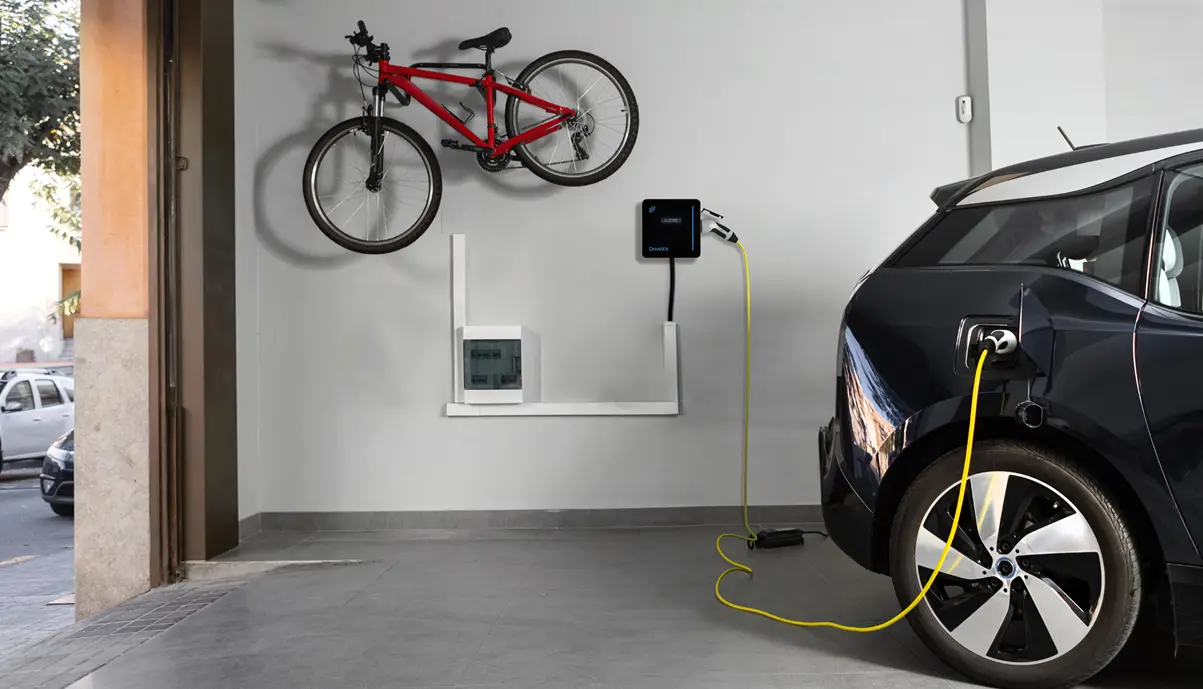
The wall-mounted charging station is the gold standard for fleets. Installed by an IRVE-certified technician, it delivers between 7.4 and 22 kW, allowing for a full charge in 3 to 7 hours. It includes a certified MID meter (required to justify URSSAF reimbursements at actual cost) as well as access management, connectivity for centralized control, and automatic transmission of consumption data to the company.
For company car fleets, the wall-mounted station is the recommended solution. It is the only option that guarantees traceability, URSSAF compliance, and long-term control over charging costs.
+CTA: Looking to equip your employees' homes with charging stations? Get a quote within 48 hours
Reimbursing charging costs: the three URSSAF models
For company vehicles, the BOSS (Official Social Security Bulletin) requires reimbursement based on actual expenses incurred (via precise readings from the charging station or meter) or via a flat-rate method rigorously justified against the employee's electricity bills. The choice of model depends on the company's equipment level and the supporting documents it is able to collect.
- Reimbursement based on supporting documents: The employee submits readings from their connected charging station, which distinguish between professional and personal kWh. The employer reimburses at the actual cost per kWh, provided that an automated tracking tool is in place.
- Direct payment via badge or card: The company provides a charging badge and pays for the sessions directly. Traceability is automatic; the operator provides a monthly statement for each employee. This option eliminates any out-of-pocket expenses for the employee.
In the case of a personal vehicle used for professional purposes, a third method is available: the electric mileage allowance, where the employer reimburses €0.05 per professional kilometer (2026 rate), without the need for meter readings. Professional mileage must be justified via a logbook, GPS export, or dedicated application. This model is applicable even if the employee charges using a standard household outlet.
In all cases, a written agreement is required. It must specify the chosen model, documentation requirements, equipment ownership, and the conditions applicable in the event of employment contract termination.
What the company can fund: 2026 tax and social framework
The current regulatory framework offers significant flexibility for employers who organize themselves correctly.
The table below summarizes the social and tax impact based on the status of the charging station at the end of the contract:
For employees living in condominiums, the Advenir program covers up to 50% of installation costs, with a cap of €960 per charging station in collective parking areas. The "right to plug" (art. L113-16 of the Construction and Housing Code) guarantees every tenant the right to have a charging station installed: notifying the building manager by registered letter is sufficient in the vast majority of cases, as they cannot oppose it without a valid reason within a 3-month period.
Home charging deployment with Qovoltis: A structured 4-step process, within 30 days

Qovoltis manages the entire installation process, so the company does not need to coordinate the various parties involved.
Reimbursement at actual cost via Linky connection
Every Qovoltis charging station is connected to the employee's Linky meter. This connection precisely measures the kWh consumed for professional use and automatically calculates the reimbursement amount based on the actual cost of electricity. Estimates and disputes are eliminated at the source.
Professional/Personal declaration via the Qovoltis app
Employees declare each session as professional or personal via the mobile app. Supporting documents are generated automatically and sent to the employer. Compliance with URSSAF requirements is ensured without any additional administrative burden for HR or finance teams.
Case study: Estimating home deployment costs
A service company with 100 employees, all with company cars, spread across 3 sites. 120 parking spaces in total.
Qovoltis solution after audit : 20 on-site charging stations + 30 home charging stations for employees, for an initial fleet of 50 electric vehicles, each covering an average of 20,000 km/year.
ItemDetailsAmountHome installation30 Qobox mini stations, IRVE installation included€55,500 (€1,850/station)Home charging savings30 vehicles × €560/year*€16,800/year
* Calculation based on a vehicle consuming 20 kWh/100 km and covering 20,000 km/year (4,000 kWh):
- Public charging: €0.40/kWh → €1,600/year.
- Qovoltis solution: €0.26/kWh weighted average (mix of on-site + home off-peak hours) → €1,040/year.
- Savings = €560/vehicle/year.
FAQ
Who covers the cost of installing the charging station at the employee's home?
The company. Qovoltis provides a comprehensive quote covering all homes. Financing via BNP Paribas is available (long-term lease or leasing over 3 to 5 years, including stations and services).
What happens if the employee leaves the company?
The charging station remains the property of the company. Qovoltis implements a retrieval or transfer procedure to another employee. This arrangement is also the most tax-efficient: returned station = zero benefit in kind.
Is it possible to equip an employee who is a tenant or lives in a condominium?
Yes. The "right to plug" (art. L113-16 CCH) applies to tenants and residents in condominiums. Notifying the building manager by registered letter is sufficient in the vast majority of cases. Qovoltis includes this verification in the preliminary feasibility study.
How is the professional portion of the charging justified?
Several methods are recognized by the URSSAF. The simplest is the logbook: the employee records each business trip (date, destination, mileage), which allows for the calculation of the professional usage portion of total consumption. If the charging station is equipped with a certified MID meter, consumption readings can be sent directly to the employer for reimbursement at actual cost. A GPS tracking app or fleet data export can also serve as proof.
Via the Qovoltis app, justification is fully automated: the employee declares each session as professional or personal use directly from their mobile device. The Linky connection ensures precise measurement of kWh consumed, and reports are generated automatically, ready to be exported for accounting and URSSAF audits.
What financial aid is available in 2026?
The CIBRE tax credit (75% up to a limit of €500) no longer applies to expenses incurred after December 31, 2025. The Advenir program remains in effect for installations in collective parking lots or condominiums (up to €960 per station). Qovoltis financing via BNP Paribas is the most direct solution for fleets looking to spread out the investment.
Key takeaways
Home charging accounts for 80% of actual electric fleet usage. Structuring this aspect through the choice of an appropriate technical solution, a documented reimbursement model, and controlled deployment is a necessary condition for the economic and regulatory viability of any electric fleet policy.
Qovoltis offers a turnkey process that handles all dimensions: technical, administrative, and financial.
Learn more
- Qovoltis business solutions
- Corporate charging stations: 2026 obligations, costs, and solutions
- Benefit in kind for electric vehicles and charging stations
- LOM Law and charging stations
- Our case studies