Summarize this article with AI
Updated on 11/12/2026
- A company can bill its employees for charging on the stations in its car park, per kWh, per minute or at a flat rate: it is the employer's choice, not an obligation.
- Until 31 December 2027, free charging at the workplace does not create a benefit-in-kind, including for employees' personal vehicles (BOSS, § 930; order of 25 February 2025, art. 4).
- For a 100% electric company car made available since 1 February 2025 and eligible for the environmental score, the electricity paid by the employer is not included in the benefit-in-kind until 31 December 2027 (order of 25 February 2025, art. 3; BOSS, § 910): charging the employee for it brings no social security advantage.
- Charging billed to employees is subject to VAT at the standard rate of 20%, and the employee pays directly with their badge or the app, each session being recorded in their name.
- A connected charging station identifies each employee by badge or app and calculates what they owe, with no expense reports or manual readings.
Workplace charging station billing means charging employees for all or part of the electricity they use in the car park: the company sets a rate (per kWh, per minute or flat rate), identifies each employee by badge or app, and the employee pays directly; it is possible, but nothing requires it. The question comes up as soon as employees charge their personal car next to company vehicles. Electricity has a cost for the company, and free charging only benefits employees who drive electric.
Timing matters too: the social security regime that neutralises free charging at work runs until 31 December 2027 (order of 25 February 2025, art. 4). The same question arises for charging paid with a company roaming charging card. This article answers the questions of HR and finance departments: can you bill, whom, with which model, which VAT to apply and how to organise payment.
Offer or bill charging: you decide
Qovoltis installs and supervises the charging stations in your car park and sets up billing according to use: fleet, employees, visitors. Reply within 48 hours.
Is a company allowed to bill its employees for charging?
Yes, a company can bill its employees for charging on the stations in its car park: no rule requires it to offer charging for free. The employer chooses between free charging, cost price or a rate that also covers management costs, and sets it out in its charging policy, communicated to employees before the first paid session.
The decision is rarely made as a whole. Three profiles share the same car park: company vehicles, whose energy the company pays for; employees' personal vehicles, for which charging can be offered or billed; visitors, customers or contractors, who can pay a separate rate. Each profile can have its own rule.
The starting point is therefore a management question: how much charging costs, who benefits from it, and what message the company wants to send to its teams. The chosen rule is communicated before the first invoice, so that no one discovers a charge without prior notice.
Is free charging at work a benefit-in-kind for URSSAF?
No, until 31 December 2027. France's official social security bulletin (BOSS, § 930) provides that the benefit-in-kind linked to the personal use of a charging station made available by the employer at the workplace is disregarded, including for vehicles owned by employees. Offering charging at the office therefore triggers no social security contributions.
The reference text is the order of 25 February 2025, art. 4: between 1 January 2023 and 31 December 2027, the non-business use of a workplace charging station is valued at zero, “including electricity costs”. The rule depends neither on the type of vehicle nor on the date it was made available. Other cases (company car, home charging station) are detailed in our guide on the benefit-in-kind of an electric vehicle and a charging station.
| Vehicle charged | Where | Free charging: social security treatment | Reason to bill it | Reference |
|---|---|---|---|---|
| 100% electric company car (whatever the date it was made available) | Workplace charging station | No benefit-in-kind | None from a social security standpoint | Order of 25/02/2025, art. 4; BOSS, § 930 |
| Plug-in hybrid company car | Workplace charging station | No benefit-in-kind | Management choice (cost) | BOSS, § 930 |
| Employee's personal vehicle | Workplace charging station | No benefit-in-kind | Management choice (cost, fairness between employees) | BOSS, § 930 |
| 100% electric company car, made available since 01/02/2025 and eligible for the environmental score | Roaming charging card | Electricity not taken into account until 31/12/2027 | None from a social security standpoint | Order of 25/02/2025, art. 3; BOSS, § 910 |
| Plug-in hybrid company car, personal use | Roaming charging card | Electricity subject to social security contributions | Separate usage with a personal card paid by the employee | BOSS, § 930 |
| Personal vehicle, personal use | Roaming charging card | Electricity subject to social security contributions | Separate usage with a personal card paid by the employee | BOSS, § 930 |
| Visitor, customer, contractor | Company charging station | Outside employees' benefit-in-kind | Visitor rate; €2 Open fee per session if the station is open to the public | Qovoltis offer |
| Employee's vehicle | Employee's home | Separate rules | See reimbursement of home charging | BOSS, § 930 |
Should you bill charging for an electric company car?
No, not for social security reasons: for a 100% electric company car made available since 1 February 2025 and eligible for the environmental score, the electricity paid by the employer is not included in the benefit-in-kind calculation until 31 December 2027 (order of 25 February 2025, art. 3; BOSS, § 910).
On a workplace charging station, charging remains free of any benefit-in-kind until the same date anyway, whatever the car (BOSS, § 930).
What will happen after 31 December 2027?
No text currently sets the rule applicable to workplace charging after 31 December 2027. A company that offers charging has an interest in tracking each employee's sessions now, to know its volumes and cost the options when the time comes.
Which model should you choose to bill employees for charging: per kWh, per minute or flat rate?
Billing per kWh is the fairest: each employee pays for the energy they use. Time-based billing encourages drivers to free up the station but penalises vehicles that charge slowly. A flat rate, per session or per month, is simple to manage but disconnected from consumption. A company can also combine the kWh rate with a penalty beyond a certain duration.
The right model depends mainly on the ratio between the number of charging stations and the number of users. With enough charging points for everyone, the kWh rate is enough: everyone pays for what they use. With few stations for many drivers, the issue becomes vehicle rotation, and a time-based rate or an overstay penalty becomes worthwhile. Sizing the installation remains the first lever: see how many charging stations to install for your fleet.
A monthly flat rate suits very regular use, for example a few employees who charge a similar volume every day. It becomes unfair as soon as consumption differs: the low-mileage driver pays for the high-mileage one. Finally, nothing prevents different rates per profile: fleet, employees, visitors.
How do you set the price per kWh billed to employees?
Start from the company's full cost per kWh, read excluding VAT on the electricity bill: supply, network and taxes, not just the supply portion. Add the share of the subscription and contracted power, supervision and maintenance. Billing at this cost price covers expenses; below it, the company subsidises charging; above it, it makes a margin.
On Qovoltis charging stations paid for by the company, Qovoltis takes no commission on the charging billed by the company: the rate set does not need to include an operator commission.
How do you identify each employee and calculate what they owe?
A connected charging station identifies each employee by RFID badge or mobile app and records each charging session: energy, duration, user. The supervision software applies the profile's rate (fleet, employees, visitors) and calculates the amount due, with no expense reports or manual readings.
On a Qovoltis station reserved for employees, access is by RFID card or badge, or through the Qovoltis app: scan the station's QR code, or select the site and then the station before starting the charge. The company can reserve the station for its employees or open it to the public.
Rates can differ by profile. They are set up by Qovoltis at the company's request, without changing equipment. The Qockpit supervision platform provides the session history and lets you export it for accounting. To equip a site, see our charging stations for your company car park.
How do employees pay for charging in the company car park?
Employees pay for charging in the company car park directly, with their RFID badge or the mobile app. Each session is recorded in their name, with the kWh consumed and the amount paid. This direct payment spares the payroll and accounting departments from managing sums to recover.
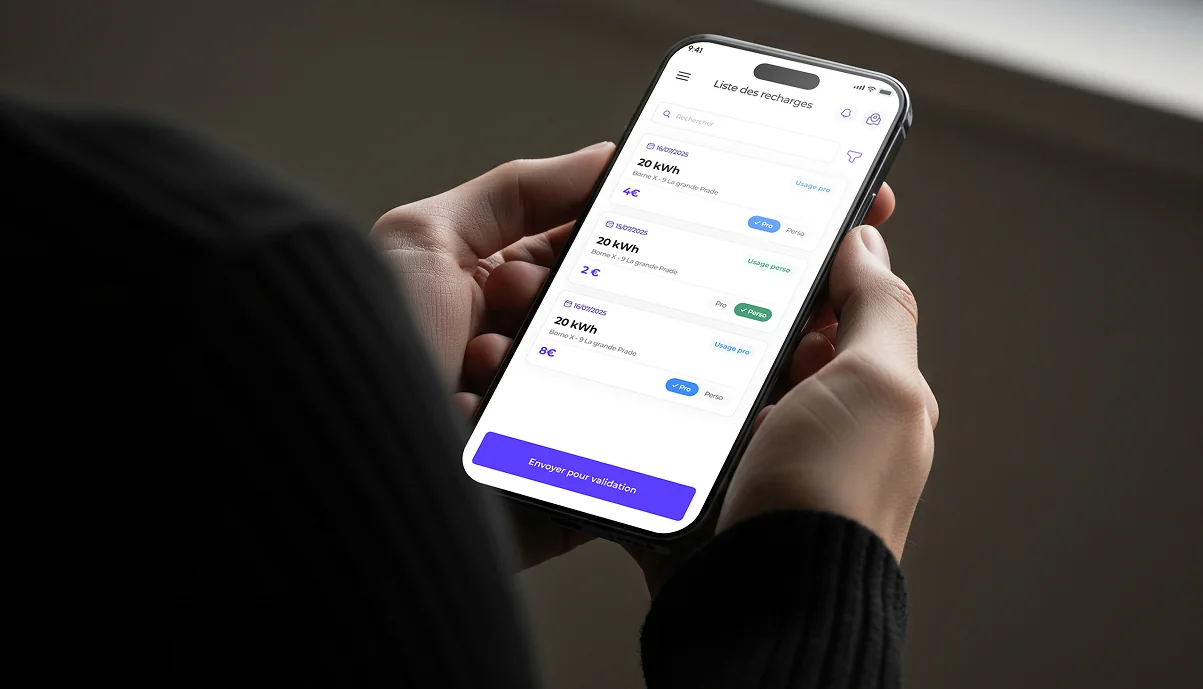
On Qovoltis charging stations, the employee pays Qovoltis, which collects the payment and issues the receipt. The amount depends on how the station is configured:
- on a station reserved for employees, the rate is the one the company has had set up for this profile;
- on a station open to the public, a user of the Open offer in the Qovoltis app pays the price per kWh plus a €2 connection fee per session.
Is charging billed to employees subject to VAT?
Yes, charging billed to employees is subject to VAT at the standard rate of 20%. The price per kWh paid by the employee includes all taxes, as on a public charging station: a company starting from a cost excluding tax therefore adds this 20% before announcing its rate.
On Qovoltis charging stations, Qovoltis collects the employee's payment and issues the receipt. Qockpit exports give accounting the details of sessions by user.
On the purchasing side, for a VAT-registered company, the VAT on electricity consumed by the company's electric vehicles “is not subject to any exclusion” and “is deductible under ordinary law conditions” (ministerial answer no. 5886, JO AN of 27 June 2023).
How do you manage employee charging with a roaming charging card?
With a roaming charging card, the company must separate business use from personal use. The rule that neutralises the benefit-in-kind until 2027 covers workplace charging stations, not the card: electricity paid for the personal use of a personal car or a plug-in hybrid company car is subject to social security contributions (BOSS, § 930).
One exception concerns a 100% electric company car made available since 1 February 2025 and eligible for the environmental score: the electricity paid by the employer is not included in the benefit-in-kind until 31 December 2027 (order of 25 February 2025, art. 3; BOSS, § 910), including with a card. For other electric company cars, the rules are detailed in our article on the benefit-in-kind of an electric vehicle.
If the employer pays for a subscription giving access to self-service charging stations, this coverage is excluded from contributions only up to 50%, until 31 December 2027 and excluding electricity costs. If the electricity portion cannot be identified in the subscription, the entire expense counts as a benefit-in-kind (BOSS, § 930).
What should you do with personal charging paid with the business charging card?
For a personal vehicle or a plug-in hybrid company car, personal charging paid with the business card is re-invoiced to the employee; otherwise, it is added to the social security contribution base (BOSS, § 930). To avoid this sorting, the simplest solution is to separate uses with two cards: a work card, not billed to the employee on the company's stations, and a personal card, billed to their bank card. This is the system used by Qovoltis.
Two cards are better than one: with a work card and a personal card, each charging session is assigned to the right use from the start, with no after-the-fact sorting of sessions between business and personal use.
How do you set up workplace charging station billing?
In five steps: define the policy (who charges, at what price, with which priorities), communicate the access and rate rules to employees, equip the car park with connected charging stations, have the rates set up by profile, then monitor consumption to adjust the rate and prepare for the 31 December 2027 deadline.
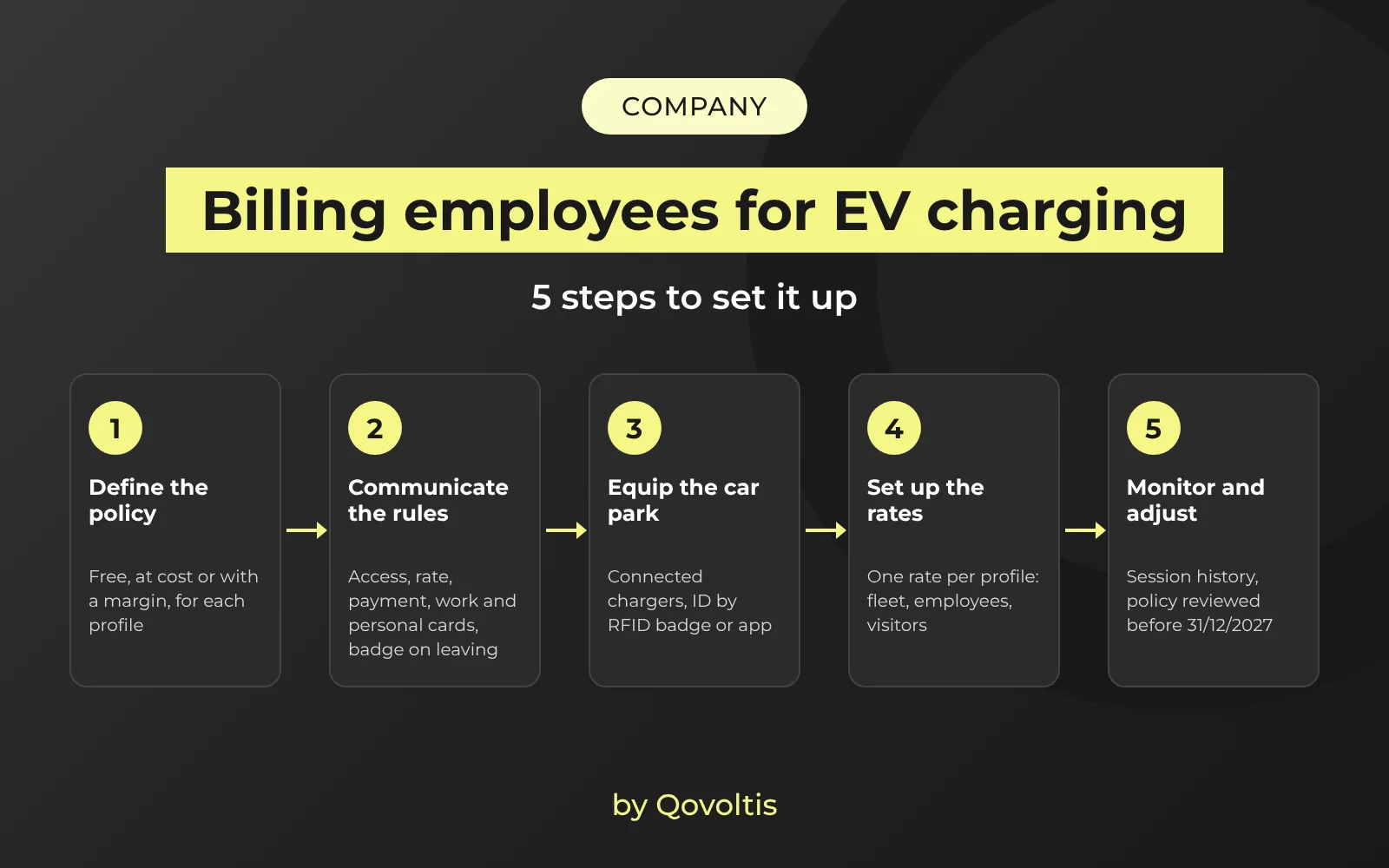
- Define the policy. Decide for each profile (fleet, employees, visitors) whether charging is free, billed at cost price or with a margin.
- Communicate the access and rate rules. Tell employees who can charge, at what rate, how to pay, how to use the work and personal cards, and that their badge is deactivated when they leave.
- Equip the car park. Connected charging stations identify each user; the number of points depends on the car park and on equipment obligations: see the price and installation of a workplace charging station.
- Have the rates set up. Each profile gets its own rate, which can then be changed through configuration.
- Monitor and adjust. Session histories show actual volumes; review the policy before 31 December 2027.
FAQ
Does free charging at the office appear on the payslip?
No. Until 31 December 2027, the benefit-in-kind linked to the personal use of a workplace charging station is disregarded (BOSS, § 930): it is not included in the social security contribution base and therefore does not have to appear on the payslip as a benefit-in-kind.
What are the employer's obligations regarding charging stations?
The obligations concern equipping car parks of non-residential buildings with charging points or pre-equipment, depending on the number of spaces and the type of building (existing, new or renovated). They impose neither free charging nor a rate. The details are in our article on equipment obligations for company car parks.
How can you prevent an employee from occupying a charging station all day?
By informing employees of the rotation rule: move your vehicle once charging is complete to make room for a colleague. A time-based rate can also encourage drivers to free up the station, but not all operators offer it.
What happens to the charging badge when an employee leaves the company?
The company deactivates the employee's badge in the supervision platform: they can no longer start a charging session on its stations. With Qockpit, badges can be assigned, activated or deactivated in a few clicks.
Can the company reimburse an employee's home charging?
Yes, depending on the vehicle concerned. The social security rules differ for a 100% electric company car, a plug-in hybrid or a personal vehicle: they are detailed in our article on reimbursement of home charging under URSSAF rules.
Let's talk about your charging policy
Charging stations in your car park, badges, roaming card and billing: our experts study your needs and tell you the legal minimum equipment. Free audit, reply within 48 hours.
Key takeaways
- Billing employees for charging is the company's choice, not an obligation, and the rule is communicated before the first paid session.
- Until 31 December 2027, free charging on a workplace charging station does not create a benefit-in-kind, whatever the vehicle (order of 25 February 2025, art. 4; BOSS, § 930).
- Billing charging for a 100% electric company car at the workplace brings no social security advantage until that date.
- The kWh rate is the fairest model; time-based billing helps rotation in a saturated car park.
- Charging billed to employees is subject to VAT at the standard rate of 20%; the employee pays directly, and each session is recorded in their name.
- With a roaming charging card, separate business and personal use, for example with two cards.
Further reading
- Benefit in kind for electric vehicles and charging stations: the 2026 guide
- Flat-rate reimbursement of home charging costs: what does URSSAF say in 2026?
- Workplace charging stations: obligations, costs and solutions 2026
- Corporate EV charging station requirements: what the law says in 2026
- Fleet charging stations: how many should your company install?
Sources and references
- Order of 25 February 2025 on the valuation of benefits in kind, art. 3 (Légifrance)
- Order of 25 February 2025 on the valuation of benefits in kind, art. 4 (Légifrance)
- BOSS, Benefits in kind, § 910 and § 930 (France's official social security bulletin)
- Ministerial answer no. 5886, JO AN of 27 June 2023 (VAT on vehicle electricity)
Article written in November 2026. Information checked at the date of publication; the social security treatment of workplace charging is set until 31 December 2027 (order of 25 February 2025, art. 4; BOSS, § 930). This article is provided for information purposes only and does not constitute legal, social security or tax advice.