Updated on 10/16/2026
Leasing EV charging stations lets your business equip its car parks and your employees' homes with no upfront outlay: the charging stations, their installation and commissioning are financed through rent spread over 3 to 5 years. You can comply with the LOM law while preserving your cash flow when investment budgets are frozen.
To explain how it works, Qovoltis hosted a webinar with BNP Paribas Leasing Solutions, the BNP Paribas group entity specializing in business equipment financing. The figures quoted during the webinar date from its recording in late 2025: this article reproduces their answers and updates them with the 2026 regulations and electricity tariffs, which may therefore differ from those mentioned in the video.
How does EV charging station leasing work for businesses?
EV charging station leasing for businesses works like equipment financing: Qovoltis designs, installs and operates the charging stations, BNP Paribas Leasing Solutions finances them, and the business pays rent under a long-term rental (LLD) or finance lease (crédit-bail) over 3 to 5 years, instead of buying the equipment outright.

Qovoltis first assesses the needs of each site and proposes the right equipment. The financing decision arrives within 48 hours (Qovoltis offer for businesses). Once the project is approved, Qovoltis handles the paperwork: the financing applies directly, through a fully digital process.
The rent also adapts to the company's pace. According to Jérémy Lille, Sales Manager at BNP Paribas Leasing Solutions, the company chooses how often it pays rent and can adjust the amounts to the seasonality of its business.
In this replay (in French), Benjamin Burry, former Sales Director at Qovoltis, and Jérémy Lille, Sales Manager at BNP Paribas Leasing Solutions, explain how leasing works and answer participants' questions.
What does the rent for a leased charging station cover?
The rent for a leased charging station finances the equipment, its installation and its commissioning. It is spread over 3 to 5 years, under long-term rental or finance lease, and the company chooses the right equipment for each site with Qovoltis. In addition, Qovoltis provides supervision and maintenance of the charging stations.
The installation is not set in stone either: it can evolve with your vehicle fleet. As new electric vehicles arrive, new charging stations can be added.
Can you lease charging stations for employees' homes?
Yes, charging station leasing applies to employees' homes as well as to the company car park. "Both options are possible, no constraints," confirmed Jérémy Lille of BNP Paribas Leasing Solutions during the webinar. A company can therefore finance charging stations at its sites, its branches and its employees' homes.
Combining the two is often what cuts the bill the most: employees charge at home overnight and top up at the office during the day, without resorting to fast charging on the road. A charging station at an employee's home costs €1,250 to €2,500 excl. VAT, installation included (installation cost of a charging station for businesses). Full details are in our guide to charging stations at employees' homes.

Leasing or buying charging stations: what impact on cash flow and accounts?
Leasing charging stations eliminates the upfront outlay and the VAT advance: the company pays rent instead of spending €2,000 to €4,000 excl. VAT per AC charging point. In French statutory accounts, the rent is deductible and the asset stays off the balance sheet; under IFRS, it is recognized on the balance sheet, with exceptions including low-value assets.
"Leasing isn't credit, it's an expense," summed up Jérémy Lille during the webinar. In practice, leasing changes how the expense appears in your cash flow and your accounts.
Sources: prices published by Qovoltis, Qovoltis x BNP Paribas Leasing Solutions webinar.
One nuance for groups reporting under IFRS: IFRS 16 brings most lease contracts onto the balance sheet, with exceptions including low-value assets (IFRS 16 standard on ifrs.org). In any case, the exact treatment of your contract should be confirmed with your accountant.
Why equip now if the investment budget is frozen?
A company subject to these rules has every reason to equip now: since January 1, 2025, the LOM law has required car parks with more than 20 spaces in non-residential buildings to have at least one charging point per 20 spaces, and the fleet greening tax for fleets of 100 vehicles or more reaches €4,000 per missing vehicle in 2026.
Is your car park subject to the LOM law requirement?
Your car park is subject to the LOM law requirement if it belongs to a non-residential building and has more than 20 spaces: since January 1, 2025, it must have at least one charging point per 20 spaces (Article L113-13 of the French Construction and Housing Code). Exemptions include car parks of buildings owned and occupied by an SME (Article L113-14).
A 60-space car park must therefore have at least 3 charging points, one of them on a space accessible to people with reduced mobility. All thresholds and exceptions are detailed in our article on the charging station requirement for businesses.
How much does the fleet greening tax cost?
The annual incentive tax on fleet greening costs €4,000 per missing vehicle in 2026, then €5,000 from 2027 (Article L421-132-3 of the French Tax Code on Goods and Services). It applies to companies with at least 100 light vehicles that do not reach their required share of low-emission vehicles: 18% in 2026, 25% in 2027.
This share is calculated on the vehicles added to the fleet during the year and the three previous years (Article L421-132-4). Electrifying a fleet without planning for charging makes no sense: the two projects go hand in hand. The full cost of an electric fleet is covered in our article on the total cost of an electric vehicle fleet over 5 years.
Are low-emission zones still in force?
Yes, low-emission zones (ZFE) remain in force: on May 21, 2026, the French Constitutional Council struck down their repeal, which had been voted in the law on simplifying economic life (Decision No. 2026-903 DC). For technicians and sales staff who work in city centers, an electric vehicle remains the safest way to keep access to their customers.
As for subsidies, don't expect a grant to equip a company car park: in 2026, the ADVENIR program offers no subsidy for car parks serving employees or light-vehicle fleets in mainland France (ADVENIR amounts). Other levers are presented in our article on subsidies for installing charging stations in businesses.
How much does a company save by charging on site or at home rather than on the road?
Off-peak charging on a private charging station costs about €0.16 incl. VAT per kWh at the regulated tariff of August 2026, versus €0.60 incl. VAT on average for fast charging on the road (Avere-France, first half of 2025). For a vehicle using 3,000 kWh per year, the difference exceeds €1,300 incl. VAT per year (about €1,100 excl. VAT), which covers part of the rent.
Sources: Avere-France, half-yearly report on charging prices, November 2025 (average prices without subscription, first half of 2025); EDF Tarif Bleu price list as of August 1, 2026 and decision of July 29, 2026, Annex B2 (regulated tariffs). Excluding electricity subscription and charging station costs.
The gap comes from fast charging, useful on a trip but expensive day to day. A technician or salesperson with no charging station at the office or at home usually charges on the road, at fast chargers. Installing a charging station in either of these places eliminates most of this expense.
How does smart charging cut the bill further?
Smart charging cuts the bill by automatically shifting charging to off-peak hours. At the regulated business tariff, a kWh costs about 24% less than at peak hours, and about 26% less for households. The driver simply plugs in the vehicle.
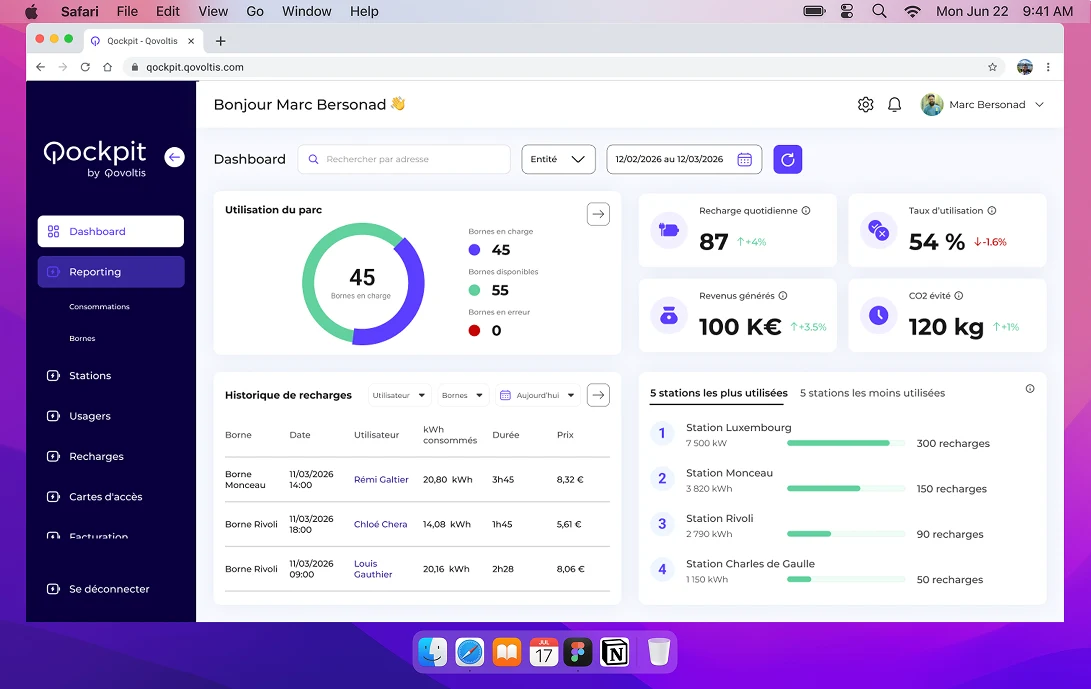
Qovoltis load management also shares the available power between the vehicles plugged in: several vehicles charge at the same time without exceeding the subscribed power, which can avoid an additional grid connection. All data feeds into Qockpit, Qovoltis's supervision platform: consumption per charging station and per site, badge management, automated billing. To estimate these savings for your fleet, use the Qovoltis charging savings calculator.
What happens if a leased charging station breaks down?
If a leased charging station breaks down, the operator handles it: remote supervision detects the fault, attempts a restart and, if needed, dispatches a technician on site. With Qovoltis, the Qockpit platform monitors the status of each charging station continuously and alerts the company if one stops working.
A charging station out of service means a vehicle off the road and an employee who cannot get to a customer. During a previous Qovoltis webinar on the cost of electric fleets, Benjamin Burry, former Sales Director at Qovoltis, explained that the team first intervenes remotely to restart the charging station (replay of the webinar on the cost of electric fleets). If a site visit is needed, Qovoltis's installation and maintenance partners go on site.
Qovoltis commits to restoring service within 72 hours. As Benjamin Burry pointed out in the webinar on leasing, this does not mean the intervention waits 72 hours: it is the maximum time within which charging must be working again.
FAQ
How much does it cost to lease a charging station for a business?
The cost of leasing a charging station depends on the number of charging points, their power, the work required and the contract length, from 3 to 5 years. There is no public price: the rent is set on a quote basis. As a benchmark, Qovoltis publishes a cost of €2,000 to €4,000 excl. VAT per alternating current (AC) charging point installed in a company car park.
What happens to a leased charging station if the employee leaves the company?
If the employee leaves the company, the charging station financed by the company can be removed by Qovoltis and reinstalled at another employee's home. The company can also choose to leave it with the employee: depending on the terms of the contract, the outstanding capital is then paid off. A charging station left with the employee may constitute a benefit-in-kind under URSSAF rules.
What happens at the end of a charging station lease contract?
Under a finance lease, the company can exercise the purchase option at the end of the contract and become the owner of the charging stations, which are then recorded as assets on its balance sheet. Under long-term rental, the end-of-contract conditions are set in the contract signed with the lender.
Key takeaways
- Leasing charging stations, under long-term rental or finance lease over 3 to 5 years, lets you equip with no upfront outlay or VAT advance.
- It finances charging stations in the company car park as well as at employees' homes, which can be reused if an employee leaves.
- In French statutory accounts, the rent is a deductible expense and the asset stays off the balance sheet; under IFRS, it is recognized on the balance sheet, with exceptions including low-value assets.
- Off-peak charging on a private charging station costs about €0.16 incl. VAT per kWh, versus €0.60 incl. VAT for fast charging on the road (first half of 2025).
- LOM requirement since 2025, fleet greening tax at €4,000 per missing vehicle in 2026 and low-emission zones maintained: for a company subject to these rules, waiting costs more than leasing.
Further reading
- Charging stations for businesses: price, installation and requirements
- Installation cost of a charging station for businesses
- Subsidies for installing charging stations in businesses
- Charging station requirement for businesses: what the law says
- Charging stations at employees' homes
- Benefit-in-kind for an electric car and its charging station
- Electric vehicle fleet: the real cost over 5 years
- Qovoltis charging solutions for businesses
Sources and references
- Replay of the Qovoltis x BNP Paribas Leasing Solutions webinar: "Installer des bornes de recharge électrique sans plomber votre trésorerie, c'est possible ?" (in French)
- Replay of the Qovoltis x Evera webinar: "Flotte automobile : réduire de 40 % son TCO grâce à l'électrique" (in French)
- Légifrance: Articles L113-13 and L113-14 of the French Construction and Housing Code
- Légifrance: Articles L421-132-3 and L421-132-4 of the French Tax Code on Goods and Services
- Légifrance: Constitutional Council Decision No. 2026-903 DC of May 21, 2026
- Légifrance: decision of July 29, 2026 on regulated non-residential electricity tariffs
- EDF: Tarif Bleu price list as of August 1, 2026
- Avere-France: half-yearly report on charging prices, November 2025
- ADVENIR: subsidies and amounts
- IFRS Foundation: IFRS 16 standard
Article written in October 2026. Information verified at the date of publication. Savings estimates are based on the stated assumptions and vary with usage and energy prices. This article is provided for information purposes only and does not constitute legal, accounting or tax advice.