Updated on 03/07/2026
Introduction
Electrifying your electric vehicle fleet means reducing costs. But it also involves managing a paradigm shift: charging doesn't work like filling up with gas. It needs to be planned, supervised, and billed. For companies that master this, it's a measurable driver of performance.
According to a prospective study published by Avere-France (Carbone 4, May 2026), the cost of ownership for an electric vehicle is approximately 45% lower than that of an internal combustion engine equivalent. However, it's crucial to rely on the right charging solution for businesses.
This guide covers legal obligations, the two key use cases, real costs, and the practical questions asked by CFOs, HR Directors, and fleet managers.
What the LOM Act Requires of Businesses in 2026
Relevant Parking Lots and Exact Thresholds
Law No. 2019-1428 of December 24, 2019, known as the Mobility Orientation Law (LOM) has required since January 1, 2025, that any non-residential car park with more than 20 spaces must include at least 1 charging station in an accessible space for people with reduced mobility (PRM), plus 1 charging station for every additional 20 spaces.
Fleet Decarbonization Obligations: The Annual Incentive Tax (TAI)
The legal framework has been tightened. The former LOM law renewal quotas have been replaced by the Annual Incentive Tax (TAI), which mandates a strict decarbonization pathway for your recent fleet:
In 2026, the annual incentive tax (TAI) reaches a maximum unit rate of €4,000 per missing low-emission vehicle, before applying the coefficient related to the fleet renewal rate. The amount actually due is calculated using the formula: TAI = €4,000 × deviation from target × fleet renewal rate.
For a fleet manager with over 100 vehicles who has not met their electric vehicle quota, the financial stakes are immediate and directly proportional to the actual renewal of their fleet.
Get your fleet audited for free
Assess your TAI exposure within 48 hours.
Exemptions and limitations
Three scenarios allow for reducing or eliminating obligations:
- Owner-occupier SMEs : total exemption if the building is owned AND occupied by an SME in the European sense (fewer than 250 employees AND turnover less than €50 million). A tenant company is not covered by this exemption.
- Charging station cost exceeding 7% of renovation cost : in the case of a major renovation, if the cost of the installations exceeds 7% of the total cost of the works, the obligation is waived.
- Upstream TGBT works (existing buildings only): if network reinforcement works upstream of the Main Low Voltage Switchboard cost more than the installation of charging stations, the number of mandatory charging stations is capped. This is not a total exemption, but a limitation.
To learn all about the LOM law, consult our dedicated article.
Two Use Cases for Workplace Charging
On-site charging (company car park)

Installing an electric vehicle charging station at a business begins in the company car park. Vehicles are parked there for 7 to 8 hours, which is a natural opportunity for low-cost charging without time constraints.
Employee productivity is not affected: the vehicle charges during office hours, with no inconvenience to the employee.
Thanks to Qovoltis' smart charging, stations adapt in real-time to the available power on site. No increase in subscribed power is needed, and no major construction work is required.
Employee home charging
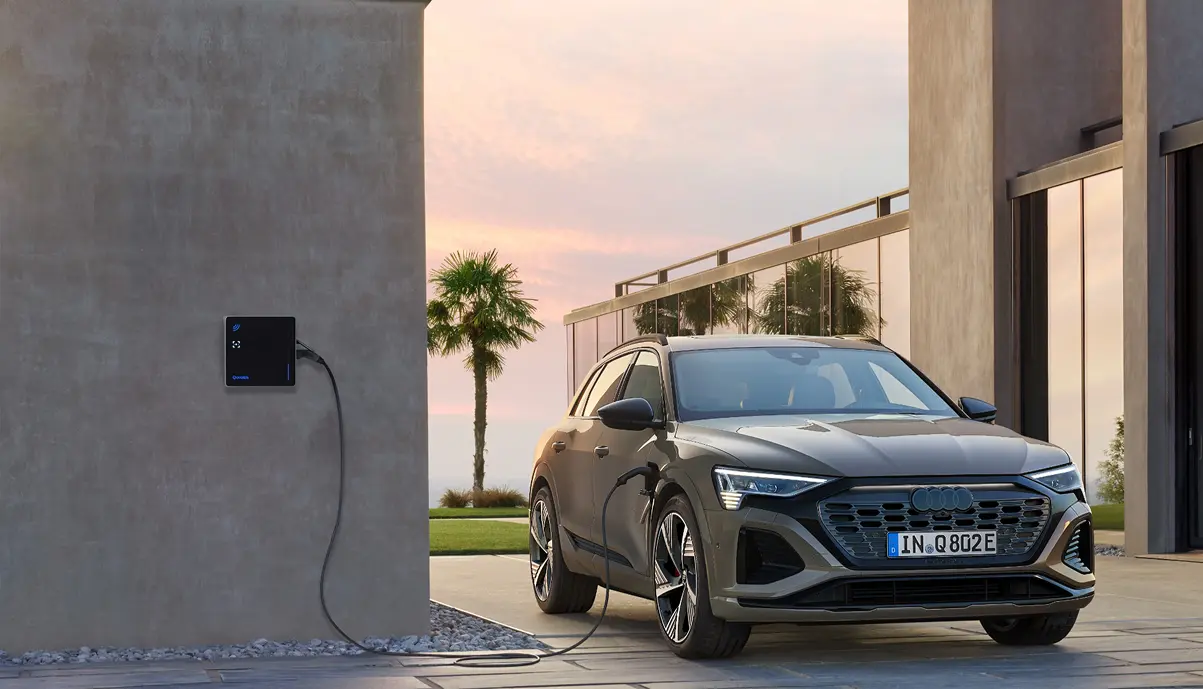
This is the most powerful lever for reducing a company's Total Cost of Ownership (TCO). Overnight home charging costs between €0.18 and €0.25/kWh during off-peak hours, compared to €0.38 to €0.85/kWh for public charging (ENGIE, 2026). For an employee driving 20,000 km per year, the savings reach €1,480 excl. tax per vehicle per year.
Installation at an employee's home takes less than 30 days, including administrative processing. And thanks to the Qovoltis mobile app, employees can declare their charges for business or personal use with a single click, automatically ensuring URSSAF and tax compliance.
How much does it cost to install charging stations for businesses?
The cost varies depending on whether the installation is on-site or at employees' homes.
Installation Process and Lead Times
On-site installations involve IRVE-certified electricians and are carried out without interrupting business operations. The process follows four phases: LOM compliance audit, technical study, construction, and finally commissioning. From purchase order to the first charge, the average lead time is 60 days.
For home charging stations at employees' residences, Qovoltis manages the entire process: online home qualification, virtual technical assessment, validation, and then installation by a certified technician. Deployment takes less than 30 days, including coordination and administrative management.
Benefit in Kind and Taxation: What You Need to Know
Electrifying a fleet raises a crucial tax question: how should electric charging be treated with regard to benefit in kind (BIK) and URSSAF regulations?
Tax Advantages Not to Be Overlooked :
- 100% Recoverable VAT: For VAT-registered companies, the entire 20% VAT on the purchase, installation, and electricity consumed for professional purposes is fully recoverable. The actual cost to your budget is the ex-VAT price.
- Full Expense Deduction: Maintenance costs, the subscription to the Qockpit supervision platform, and electricity consumption are 100% deductible from the company's taxable income.
- Accounting Depreciation: Charging stations are recorded as tangible fixed assets and are depreciated over a standard period of 5 to 10 years (7 years being the observed average useful life), reducing taxable income each year.
The government offered a tax "incentive" that allowed companies to depreciate (account for as a loss) 100% of the charging station's price in just 12 months. This scheme ended on December 31, 2025.
In 2026, the standard rules apply: a charging station is normally depreciated over several years (like a machine or a computer). As for the "20% accelerated depreciation," it does not apply to charging stations, only to large electric trucks.
For details on the 2026 BIK scales, our dedicated article on benefit in kind covers all scenarios.
How to manage and monitor your corporate charging
A monitoring solution allows you to:
- Track real-time consumption per charging station, per site, and per employee
- Automatically separate business and personal charging sessions
- Automate invoicing and expense report generation
- Control access via RFID badge or mobile app
- Export data for CSR reporting and URSSAF obligations
For multi-site companies, centralized monitoring provides a consolidated view of the entire fleet, facilitating TCO management and extra-financial reporting (CSRD, BEGES).
At Qovoltis, it's Qockpit that provides this monitoring: real-time dashboard, badge management, automated invoicing, and multi-site reporting from a single interface.
Case study: a company with 100 employees
A service company with 100 employees, all with company cars, spread across 3 sites. A total of 120 parking spaces, meaning a LOM obligation of at least 6 charging points.
Qovoltis solution after audit : 20 on-site charging stations + 30 charging stations at employees' homes, for an initial 50 electrified vehicles traveling an average of 20,000 km/vehicle/year.
*The energy cost of €52,000 is based on 200,000 kWh annually at an average weighted price of €0.26/kWh (mix of on-site charging during off-peak hours + home charging).
FAQ
Are there still support schemes for businesses in 2026?
The ADVENIR program stopped funding corporate fleet and employee projects in 2023. The scheme that allowed companies to depreciate 100% of the charging station cost in just 12 months ended on December 31, 2025. Some support schemes still exist: Energy Savings Certificates (CEE), as well as certain regional grants. BNP Paribas financing via Qovoltis (long-term lease or finance lease over 3 to 5 years) remains the most direct solution for spreading out the investment.
How to monitor and re-bill charging?
Monitoring relies on three pillars: session traceability (who, when, how many kWh), professional/personal separation, and automated billing. Without these tools, expense reports are time-consuming, and the risk of fraud is real. The Qovoltis application handles these three points for the employee; the monitoring platform centralizes data for the company and exports it for accounting and URSSAF reporting.
Who pays for electricity when an employee charges at home?
The employer reimburses the professional portion via automated expense reports. The personal portion remains the employee's responsibility.
Who owns the charging station installed at the employee's home?
The company. If the employee leaves, the charging station can be recovered or transferred.
Key takeaways
Electrifying your fleet isn't an additional expense; it's a way to reduce TCO. Qovoltis-managed charging costs €0.26/kWh, compared to €0.40/kWh without monitoring, representing a 35% saving on energy costs. Add home charging, and the savings exceed €1,480 ex-VAT per vehicle per year.
The LOM law sets a minimum framework. However, companies that equip beyond the legal minimum, by combining on-site and home charging with appropriate monitoring, are those that truly control their electric mobility budget and ensure adoption by their employees.
To learn more
- Qovoltis Business Solutions
- LOM Law and Charging Stations
- Electric Vehicle and Charging Station Benefit-in-Kind
- Qockpit - Qovoltis Monitoring Tool
- The benefits of smart charging
- Our Case Studies
Sources and References
- Avere-France, Electra, EDF — LCV Prospective Study, Carbone 4, May 2026
- ENGIE — Electric Vehicle Charging Costs 2026
- Légifrance — Law No. 2019-1428 of December 24, 2019