Updated on November 4, 2026
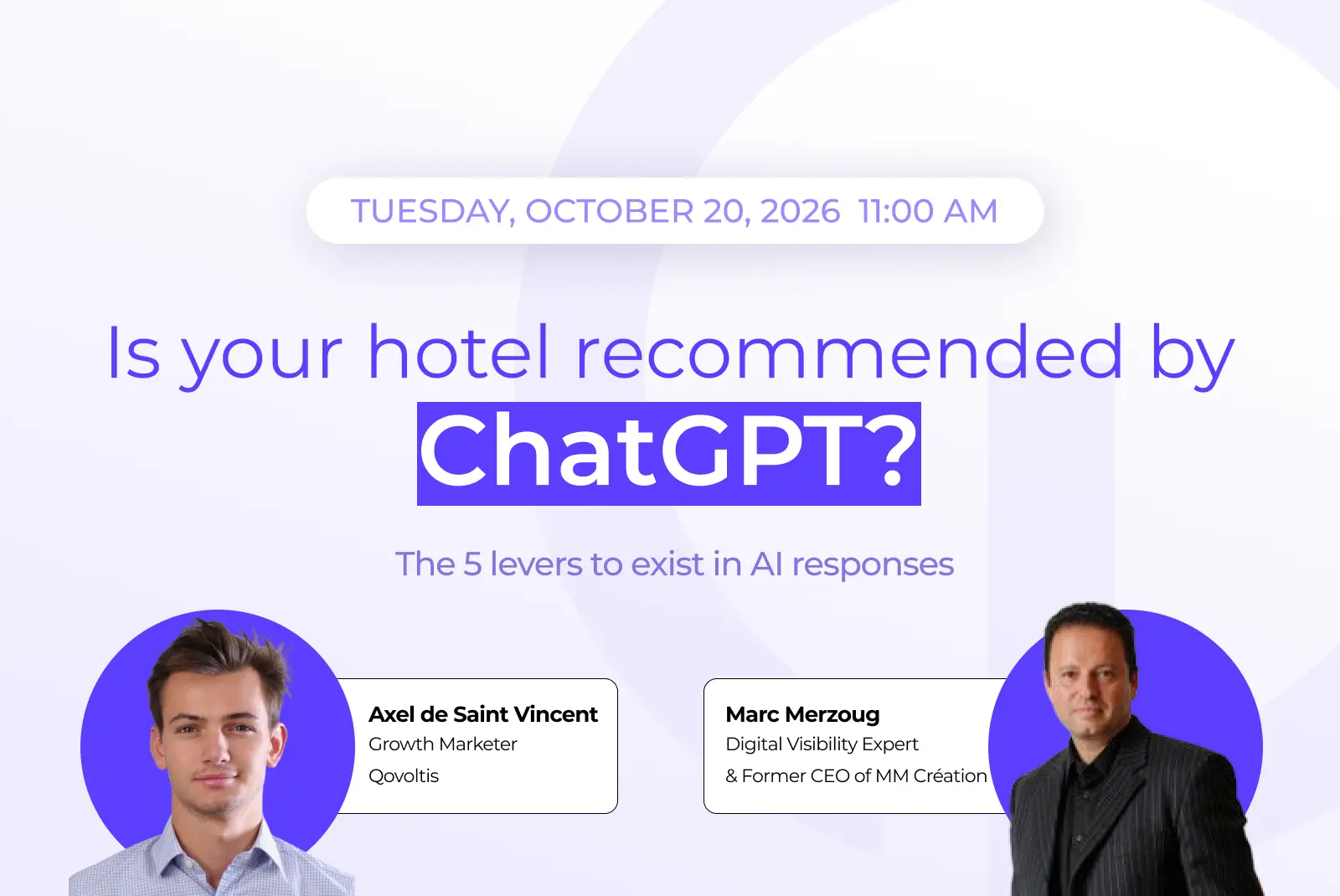
Travelers no longer just type “hotel Annecy” into Google. They ask ChatGPT: “Which quiet hotel near the lake, with parking and an EV charging station, for a romantic weekend?” The answer comes down to a handful of names. If yours isn't one of them, you're not even in the running. It's not only a question of hospitality or ratings: it's also a question of information that is available and consistent across the web. On October 20, 2026, Qovoltis dedicated a webinar to this question with Marc Merzoug, a digital visibility expert: how AIs build their recommendations, what a live demonstration revealed, and five concrete actions to appear in them. Watch the full replay below (in French), and read the key points in this article.
Why does ChatGPT recommend a competing hotel instead of yours?
Because ChatGPT, Gemini and Perplexity don't judge your hotel: they judge what they can read and verify about it. A generative AI breaks the traveler's request down into criteria (neighborhood, budget, parking, breakfast, accessibility, EV charging...), then looks for properties where each criterion is confirmed by reliable sources.
As Marc Merzoug summed it up during the webinar, an AI has read everything, but it will never set foot in your hotel: if it isn't written about you, it doesn't exist, even if the amenity exists on site.
Three points to keep in mind:
- It isn't a quality ranking. The AI looks for the property that best matches the request, not the best hotel. A lower-rated but better-described competitor can therefore get ahead of you.
- Being cited matters more than position. The AI only offers a short list: the order varies from one user to another, but a hotel missing from the list disappears.
- Every answer is personalized. The AI takes the user's history into account (an electric car driver will be offered hotels with a charging station, for example), and the same question can produce different answers. To test your hotel's visibility, use a private browsing window, without being logged in.
That's also what sets an AI search apart from a Google search: people no longer type three or four words (“hotel Annecy pool”), they describe a precise intent, which the AI refines as the conversation goes on. So it needs detailed information to make the best recommendation.
Do French travelers really use AI to plan their trips?
Yes, and it's growing fast. According to Phocuswright, 40% of French travelers used AI to plan a trip in 2026, compared with 19% in 2025 and 9% in 2024 (L'Echo touristique). And AI is no longer just for inspiration: among French travelers who use it, 92% say it influenced an actual travel decision (Phocuswright, Europe Consumer Travel Report 2026). Usage is higher among younger people: according to a YouGov survey for Evaneos conducted in March 2026, 37% of 18-34 year-olds have already asked an AI about a trip (L'Echo touristique).
The same survey shows that 74% of French people feel the need to check what AI tells them. In other words, being mentioned by ChatGPT isn't enough: most French people then want to check what they were told.
Key figures to remember:
Why pay attention to this now?
Because habits are changing very fast. The share of travelers in France who use AI to plan their trips has more than doubled every year: 9% in 2024, 19% in 2025, 40% in 2026. And when AI is used, it weighs on the final choice: 92% of French travelers who use it say it influenced an actual travel decision.
These new habits are being formed right now. Taking an interest today gives you time to understand how these recommendations work and to explore this new channel before it becomes the norm, so you can stand out rather than play catch-up with your competitors.
That doesn't mean giving up on Google. According to Marc Merzoug, the search engine hasn't lost volume: searches on Google and on AI tools add up. SEO and GEO (Generative Engine Optimization, optimizing for AI engines) share a common foundation, your website content, but what is enough for SEO isn't enough to be recommended by an AI.
What did the live demonstration show?
During the webinar, the speakers asked ChatGPT, in private browsing, the request of a couple looking for a wedding venue near a tourist town, with a few specific criteria. Four properties were cited. Yet six other hotels met the same criteria and were not cited.
The quality of the properties had nothing to do with it, Marc Merzoug stressed: the difference came from the information available about them. To build its answer, the AI doesn't rely on your website alone. It cross-checks what it learned during training with sources it consults live: official websites, booking platforms, tourist offices and above all guest reviews, a “source of truth” according to Marc Merzoug, because it's the guests speaking. Your replies to reviews are read too: if a guest asks how to charge their electric car, replying that you have charging stations available is information the AI can pick up.
What does this have to do with EV charging?
An EV charging station is a precise criterion, easy for a traveler to ask for (“hotel with EV charging near Bordeaux”) and easy for an AI to verify... provided the information is published everywhere.
And the gap is already visible on booking platforms: on Booking.com in France, only 9,636 properties out of 319,034, or about 3% of listings, remain visible when the “EV charging station” filter is applied (Qovoltis analysis of Booking.com, August 2026). And the demand is there: according to a YouGov survey for Monta published in 2023, 41% of electric vehicle owners are inclined to choose accommodation that offers charging (Automobile Propre).
A hotel that has charging stations but doesn't state it clearly (website, Google Business Profile, Booking) is therefore missing out on some of these recommendations. The webinar demonstration illustrated this with a charging-focused search, where three scenarios emerged:
- A hotel that was cited: its charging stations are mentioned on its official website, along with their type, and it appears in specialized charging directories.
- A property missing from the first answers: its charging stations appear on booking platforms and in directories, but not on its official website. The AI sees this as an inconsistency.
- A hotel cited thanks to a guest review that mentioned the charging station, even though the information wasn't highlighted anywhere else.
The lesson applies to all your services, not just charging: pool, spa, gym or parking, you never know which one will be the traveler's deciding criterion. A single service missing online can be enough to exclude you, even if the rest of your offer is excellent.
To learn more on this topic, read our complete guide to EV charging stations for hotels and our article on third-party investment to equip your hotel at no cost.
The 5 actions to get ChatGPT to recommend your hotel
Marc Merzoug and Axel de Saint Vincent defined five actions to start on right away. They can take time, but AI itself can help you carry them out, as long as you always review and check what it produces.
1. Check and claim all your listings
This is the common foundation of SEO and GEO. Start with your Google Business Profile: Marc Merzoug has seen hotels climb significantly in Google simply by filling it out completely. Also encourage your guests to leave reviews on Google.
Then check your listings on booking platforms (Booking, Expedia...), which AIs consult to cross-check information: photos, descriptions, amenities, frequently asked questions. Your official website should be at least as complete as these platforms, which often isn't the case.
Two questions asked by participants during the webinar:
- Room category names differ from one site to another? Avoid overly original names and choose a classification travelers understand. It matters less than an inconsistency in factual data, such as a hotel listed with 48 rooms in one place and 47 in another.
- Do you need to sign up on Hotels.com if you're already on Expedia? No, both brands share the same database: the information and prices are the same.
2. State things explicitly on your website
A description like “Welcome to our magnificent hotel” tells an AI nothing. Add context: the location, the guests you welcome (weddings, seminars, families), your services, distances to points of interest (“15 minutes from...”). It's useful for your guests and excellent for AI.
Add an FAQ to every page (rooms, services, access, activities around the hotel) and feed it with the questions your front desk hears most often: if guests ask them on site, others ask them before booking. Over time, an up-to-date knowledge base for your property lets you share the same information everywhere.
3. Align your information everywhere
AI compares sources with one another and can exclude a property whose information is contradictory. During the webinar, a test on one hotel revealed, for example, different check-out times depending on the platform. The right habit: regularly ask an AI, for example every month, to analyze everything published about your hotel to spot inconsistencies, then fix them, starting with your official website.
The main sources consulted by AIs, and the mistakes that can penalize you:
Research on GEO points the same way: a study by researchers from Princeton and IIT Delhi, presented at the KDD 2024 conference, showed that adding statistics, quotations and sources to a page increases its visibility in generative answers by up to 40%, while keyword stuffing performs worse than an unoptimized page (Aggarwal et al.).
4. Be listed where the context leads
Depending on the request, the AI also consults specialized sites. For charging, that means charging station directories such as Chargemap or Electroverse. For a wedding, reception venue websites. For a seminar, event venue platforms. Identify the sites related to your clientele and check that your property is listed there, with up-to-date information.
5. Make your website readable by AI crawlers
AIs need to be able to access your website and read it easily. You can block their crawlers, but you then jeopardize your presence in their answers. Structured data and FAQs make reading easier. Crawler access is a technical point to discuss with the agency that manages your website: the more structured your information, the more accurately AIs will present it.
Who hosted the webinar?
- Axel de Saint Vincent, Growth Marketer at Qovoltis. He drives Qovoltis's visibility among hoteliers, including in the answers of generative AI engines.
- Marc Merzoug, digital visibility expert and former CEO of MM Création, a web agency that has supported thousands of hotels with their digital presence.
FAQ
When did the webinar “Why is a competing hotel recommended by ChatGPT instead of yours?” take place?
The webinar took place on Tuesday, October 20, 2026, online and in French. The replay is available for free on this page and on the Qovoltis YouTube channel.
Why doesn't ChatGPT recommend my hotel?
ChatGPT doesn't visit your property: it cross-checks the information published on your website, your Google Business Profile, booking platforms and reviews. If this information is incomplete or inconsistent, the AI may recommend a better-documented property, even a lower-rated one.
How can I find out whether ChatGPT recommends my hotel?
Ask ChatGPT the question one of your guests would ask, in private browsing and without being logged in: on your own account, your history can skew the result. Run the test several times, as answers vary from one time to the next.
Should you invest in advertising on ChatGPT?
It's still very early. Ads only appear on free accounts. Based on Qovoltis's first tests, the cost per thousand impressions is low, but targeting remains broad and doesn't yet allow you to target very specific requests. Marc Merzoug recommends testing with a small budget if you can afford it, and otherwise focusing on proven channels such as Google Hotel Ads.
How can you measure your hotel's visibility in AI?
Google Search Console already shows when your pages are cited in Google's AI answers. Tools such as HubSpot or Ahrefs also offer AI visibility metrics: their results don't fully match yet, but they let you track a trend.
Who is this webinar for?
Hotel directors and owners, marketing managers and revenue managers, and hotel groups who want to appear in the recommendations of ChatGPT and other generative AI tools.
Key takeaways
- 40% of French travelers used AI to plan a trip in 2026, more than double the 2025 figure.
- An AI doesn't recommend the best hotel but the one whose information best matches the request: what isn't written doesn't exist.
- Your website, Google Business Profile, booking platforms and reviews must say the same thing, amenities included (parking, EV charging, accessibility).
- The webinar's 5 actions: complete listings, explicit information, consistency across sources, presence on context-related sites, a website readable by AI crawlers.
Further reading
- Booking.com and EV charging stations: how to appear in the filter and why you should do it
- EV Charging Stations for Hotels: The Complete Guide by Qovoltis
- Third-party investment and hotel charging stations: the business model explained
- EV charging stations for Logis Hôtel: the differentiating advantage for independent hoteliers
- Qovoltis's offer for hotels
Sources and references
- Phocuswright, 2024-2026 data on travelers' use of AI, via L'Echo touristique : « Voyageurs et intelligence artificielle : les chiffres clés de 2026 »
- Phocuswright, « AI isn't just for research anymore: what European travelers are actually doing with it », Europe Consumer Travel Report 2026
- YouGov survey for Evaneos, March 2026, via L'Echo touristique, April 23, 2026
- YouGov survey for Monta (2023), via Automobile Propre, June 30, 2023
- Qovoltis analysis of Booking.com results in France (August 2026)
- Webinar replay “Pourquoi ChatGPT recommande un hôtel concurrent à votre place ?” (in French), Qovoltis, October 20, 2026, YouTube
- Aggarwal et al., “GEO: Generative Engine Optimization”, arXiv 2311.09735 (KDD 2024)
Information verified at the time of publication. The figures cited come from third-party studies and may change.