Updated on 11/05/2026
A campsite is only required to install charging stations in the car park of certain buildings, but as soon as it offers charging to its guests, it must in principle follow the rules on installation, access, payment and price display that apply to publicly accessible charging points. These obligations depend on two questions: does its car park fall within the scope of the French mobility orientation law (LOM), and does it offer a charging station to its guests? For a campsite manager, the challenge is twofold: knowing whether they must equip their car park, and staying compliant as soon as they install a charging station, even one reserved for guests. Here is each obligation, with the reference texts.
Does the LOM law require a campsite to install electric car charging stations?
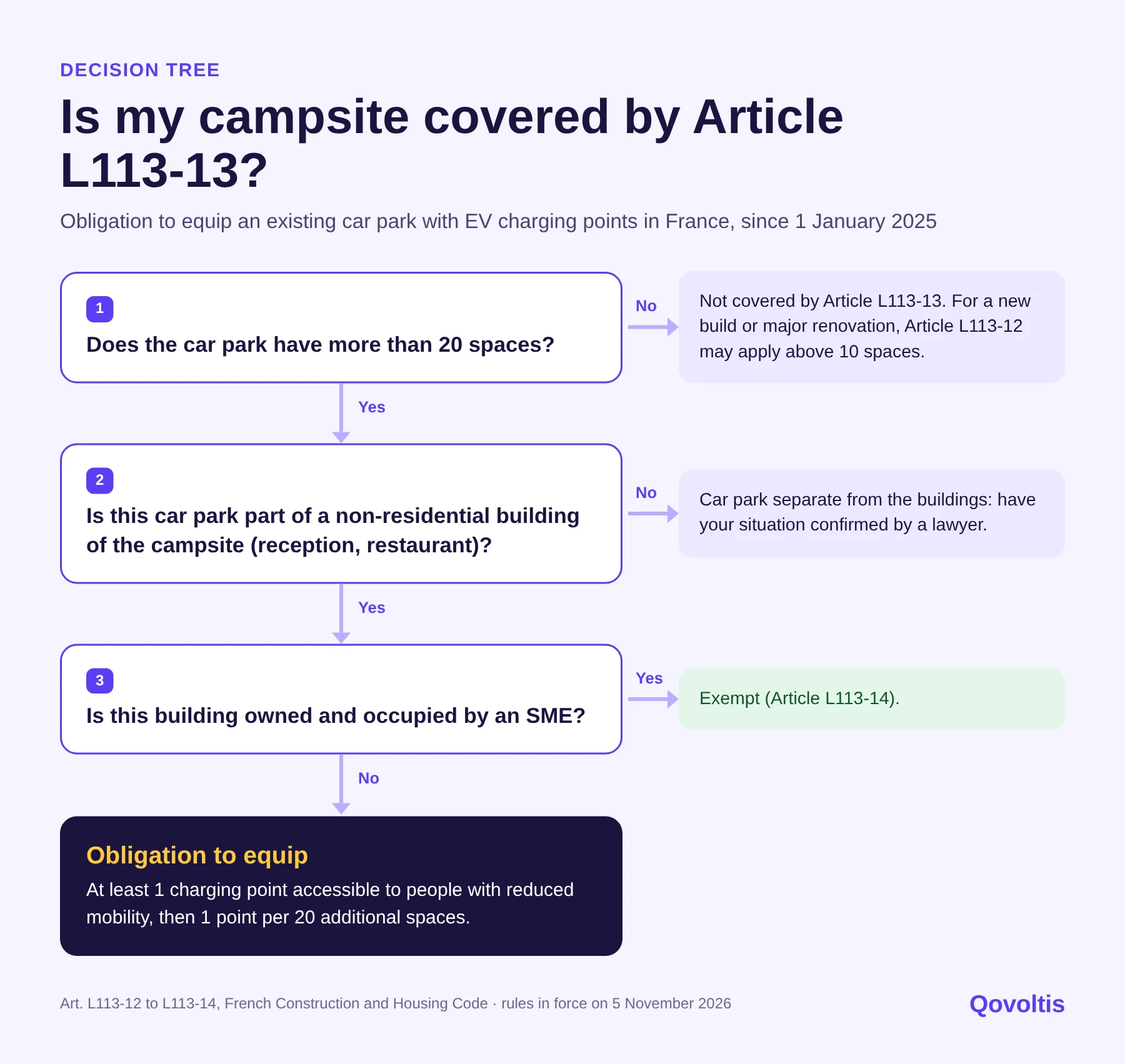
It depends on its car park: Articles L113-12 and L113-13 of the French Construction and Housing Code apply to non-residential buildings and their car parks. A campsite is concerned when one of its non-residential buildings (reception, restaurant) includes a car park, in two cases: an existing car park with more than 20 spaces (Article L113-13), or a car park with more than 10 spaces during construction or a major renovation (Article L113-12).
Both obligations exclude buildings owned and occupied by an SME. Article L113-13 refers to buildings “including a car park”: if your car park is separate from your buildings, have your situation confirmed by a lawyer.
How many charging points does a car park need?
Since January 1, 2025, an existing car park with more than 20 spaces must have at least one charging point accessible to people with reduced mobility (PRM), then one point per 20 additional spaces (Article L113-13). According to the example given by Entreprendre.Service-Public, a car park with 95 spaces must have at least 4 points, including 1 accessible to PRM. The number of points per 20 spaces can be limited if the work required upstream of the main low-voltage switchboard, including on the switchboard itself, costs more than the work carried out downstream.
Which campsites remain subject to the obligation to equip?
Campsites whose car park exceeds the thresholds and whose buildings are not both owned and occupied by an SME remain subject to the obligation to equip. The exemption in Article L113-14 refers to the European definition of an SME: fewer than 250 employees and a turnover of up to €50 million or a balance sheet of up to €43 million, taking into account, where applicable, linked or partner enterprises. Campsites run by a company that exceeds these thresholds therefore remain subject to the obligation. When the operator does not own the buildings, the dual “owned and occupied” condition must be checked case by case.
What changes with a building permit or a major renovation?
For a car park with more than 10 spaces located inside or adjoining the building, construction or a major renovation requires at least 20% of spaces to be pre-equipped and at least one space to be equipped for charging, accessible to PRM. Above 200 spaces, two spaces must be equipped, including one reserved for PRM (Article L113-12). A renovation is major if its cost reaches at least 25% of the value of the building, excluding land, and only if it includes the car park or the building's electrical installation. The obligation does not apply if the cost of the charging and connection installations exceeds 7% of the total renovation cost, and the SME exemption in Article L113-14 also applies.
The thresholds that apply to all buildings are detailed in our guide to LOM law obligations for car parks.
Who can install a charging station at a campsite?
At a campsite, a charging station must be installed by a company holding an IRVE qualification issued by an accredited body (Article D353-2 of the French Energy Code). Only installations of 3.7 kW or less in a private residential building or an outbuilding, not accessible to the public, are exempt. For any new charging infrastructure above 36 kW, a certificate of compliance approved by Consuel is also required (Consuel IRVE newsletter, April 2026).
Is an electrical design study required before installing charging stations at a campsite?
Yes, if the car park has at least 50 spaces: an electrical design study, carried out by a qualified professional, is mandatory before creating the charging infrastructure (Article D353-2 of the French Energy Code). Below 50 spaces, this formal study is not mandatory.
Is a charging station reserved for campsite guests publicly accessible?
Yes, a charging station reserved for a campsite's guests is in principle considered publicly accessible. Recital 11 of the European AFIR Regulation on alternative fuels infrastructure states that a charging point located on private property accessible to the public remains publicly accessible even when access is limited to customers. According to the European Commission's questions and answers on AFIR, a group of people who can become customers at any time is not a “limited and determinate group of persons”: only car parks reserved for identified persons, such as a company's employees, fall outside this definition. According to the same Q&A, pre-booking or identification at the gate is not enough, in itself, to turn customers into a “limited and determinate group of persons”.
French Decree No. 2017-26 uses a non-discriminatory access criterion, which does not prevent conditions of authentication, use and payment from being imposed.
What obligations apply to a publicly accessible charging point?
A publicly accessible charging point must display nearby its identifier, access information and a contact in case of breakdown (Article 18 of Decree No. 2017-26), state the price of the service (Article 19 of Decree No. 2017-26) and be connected to a supervision system (Article 11 of Decree No. 2017-26). A single station of 36 kVA or less, with no more than 5 points and not integrated into a network, is exempt from supervision: the operator must then ensure, by appropriate means, that the points work at all times.
Which payment methods must a campsite charging station accept?
Any publicly accessible charging station installed since April 13, 2024 must allow ad hoc payment, without a contract (AFIR Regulation). Below 50 kW, one solution is enough: a card reader, contactless payment or secure online payment via QR code. From 50 kW, payment by bank card or contactless is mandatory; a QR code alone is no longer enough, according to Avere-France.
How can a campsite bill for electric vehicle charging?
A campsite can charge its guests for electric vehicle charging. Legally, charging is a service and not a resale of electricity (Article L334-4 of the French Energy Code), provided that all the electricity is bought from an authorised supplier. For a publicly accessible charging station, the price must be displayed before charging, in a clear, transparent and non-discriminatory way.
Can a campsite charge a flat rate rather than per kWh?
Yes, below 50 kW. The AFIR Regulation allows a price per kWh, per minute or per session, provided that each price component is displayed before charging. The display can be electronic, via a QR code or a link on the charging station, according to Avere-France. To choose a pricing model suited to your season, see our guide to the cost and installation of an EV charging station at a campsite.
Can a campsite ban charging on pitch sockets?
Nothing prevents it: a campsite can ban electric car charging on its pitch sockets in its internal rules, which campers must follow. The model set by the Order of 17 February 2014 does not mention electric vehicle charging, so the clause must be drafted carefully. Every campsite must have internal rules, displayed at the entrance and at reception, which guests accept by staying. If a clause of the rules is not respected, the manager can serve the camper with a formal notice, then, in the event of a serious or repeated breach, terminate their contract. Have the wording of the clause checked by a lawyer.
How can a campsite offer charging without investing in charging stations?
A campsite can entrust its charging stations to an operator under a third-party investment model. The operator finances, installs and operates the stations: it relies on IRVE-qualified professionals and manages ad hoc payment, price display, supervision and maintenance. The campsite provides the parking spaces, with no investment, and earns a commission on each charging session.
With the Qovoltis third-party investment EV charging station for campsites, used in 500 hotel and leisure establishments, your investment is €0. Qovoltis handles installation, ad hoc payment without an account (QR code and bank card), roaming (Chargemap, Izivia) and price display. Qovoltis also manages charging point identifiers, data transmission, 24/7 remote supervision, smart power sharing and maintenance.
FAQ
Does a campsite have to declare its charging stations?
Yes, for a publicly accessible charging station. The operator, or the person they designate, publishes the location and technical characteristics of the station according to the IRVE schema on data.gouv.fr, within one month of commissioning (Order of 4 May 2021).
Does a campsite have to install charging stations if its car park has 20 spaces or fewer?
No, not under Article L113-13, which applies to car parks with more than 20 spaces. However, construction or a major renovation of a non-residential building whose car park has more than 10 spaces may require pre-equipment and the equipment of at least one space (Article L113-12).
Does a campsite have to display the price of charging?
Yes, for a publicly accessible charging station. The price of the service must be stated (Article 19 of Decree No. 2017-26), and the AFIR Regulation requires it to be displayed before charging, in a clear, transparent and non-discriminatory way.
Must electricity be bought from an authorised supplier to bill for charging?
Yes, this is the condition for charging to be a service and not a resale of electricity: all the electricity must be bought from an authorised supplier (Article L334-4 of the French Energy Code).
Is there a penalty if a campsite subject to the obligation does not install a charging station?
No specific penalty is mentioned by Entreprendre.Service-Public for a car park subject to the obligation that does not install a charging station. The obligation has nevertheless applied since January 1, 2025 to the car parks concerned.
Key takeaways
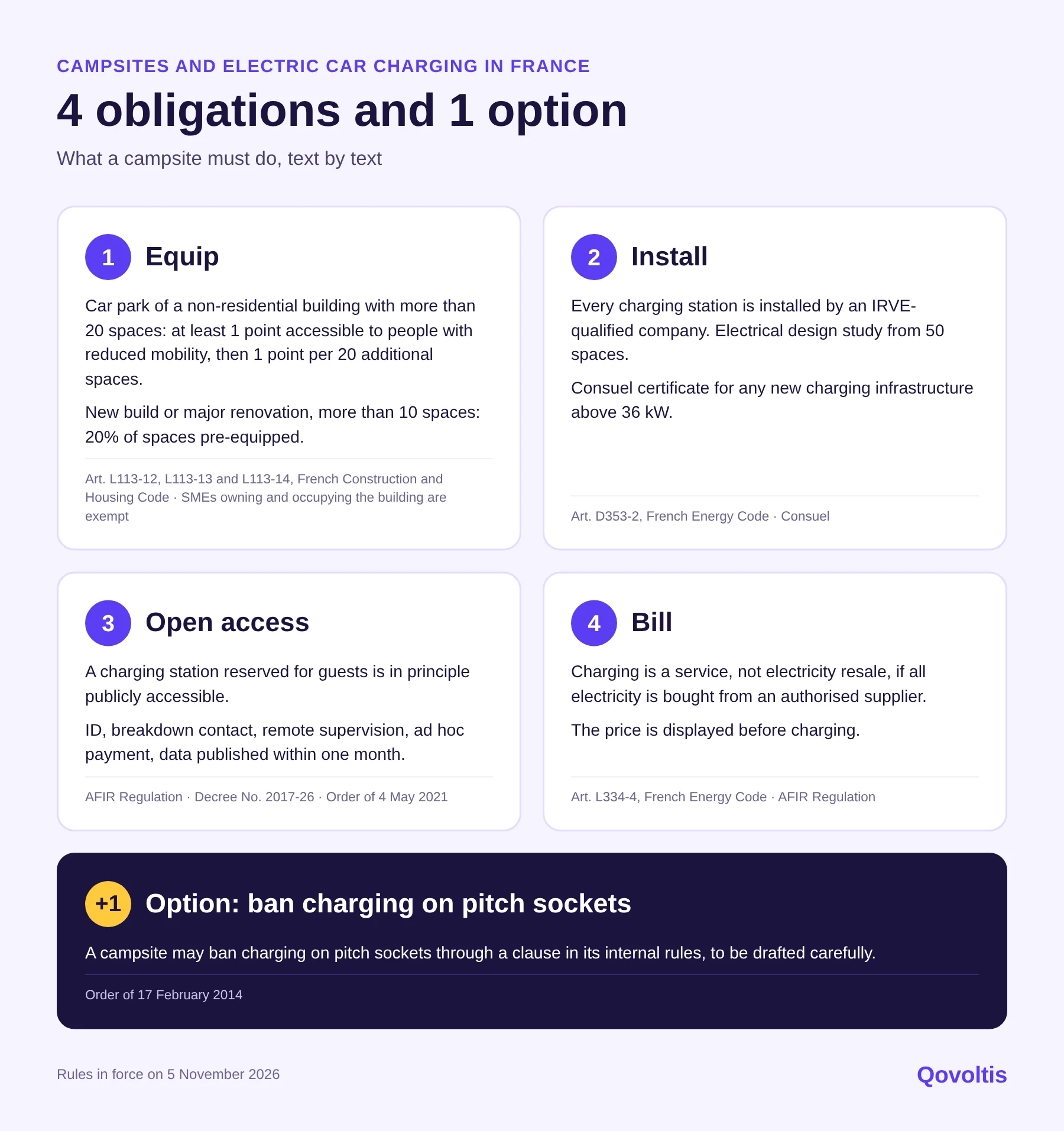
- Equip: car parks of non-residential buildings with more than 20 spaces (Article L113-13) or more than 10 spaces during construction or a major renovation (Article L113-12), excluding SMEs that own and occupy the building (Article L113-14).
- Install: IRVE-qualified company (Article D353-2), design study from 50 spaces, Consuel for any new infrastructure above 36 kW.
- Open access: a charging station reserved for guests = in principle publicly accessible (AFIR Regulation).
- Bill: a service (Article L334-4 of the French Energy Code), price displayed before charging.
- Ban charging on sockets: clause in the internal rules (Order of 17 February 2014), to be drafted carefully.
To learn more
- EV charging station for campgrounds: costs, LOM law and installation
- LOM law and charging stations: obligations for all buildings
- Reinforced socket or wallbox: which charging solution?
- The Qovoltis offer for campsites
Sources and references
- Article L113-12 of the French Construction and Housing Code (Légifrance)
- Article L113-13 of the French Construction and Housing Code (Légifrance)
- Article L113-14 of the French Construction and Housing Code (Légifrance)
- Article D353-2 of the French Energy Code (Légifrance, IRVE qualification and design study)
- Article L334-4 of the French Energy Code (Légifrance)
- Decree No. 2017-26 of 12 January 2017 on electric vehicle charging infrastructure (Légifrance)
- Decree No. 2024-649 of 30 June 2024 (Légifrance)
- Consuel IRVE newsletter, April 2026 (Consuel)
- Order of 17 February 2014 on the model internal rules for campsites (Légifrance)
- Order of 4 May 2021 on data for charging stations and points (Légifrance)
- Law No. 2019-1428 of 24 December 2019 on mobility orientation (LOM law) (Légifrance)
- DDADUE bill No. 2518, legislative file (French National Assembly)
- DDADUE bill: adoption at first reading by the Senate (Seban Avocats)
- DADUE bill: transposition of Directive (EU) 2024/1275 (Seban Avocats)
- Regulation (EU) 2023/1804 on the deployment of alternative fuels infrastructure (AFIR) (EUR-Lex)
- Commission Recommendation 2003/361/EC concerning the definition of micro, small and medium-sized enterprises (EUR-Lex)
- Questions and answers on Regulation (EU) 2023/1804 (European Commission)
- Mandatory electric vehicle charging infrastructure (Entreprendre.Service-Public, checked on 06/12/2026)
- The AFIR Regulation has officially entered into application (Avere-France, 06/05/2024)
- Publicly accessible charging infrastructure: what to remember from the new decree (Avere-France, 05/05/2021)
Article written in November 2026. Information checked on the publication date, based on the texts in force, including Articles L113-12, L113-13 and L113-14 of the French Construction and Housing Code and the AFIR Regulation. EV charging regulations change: check the texts in force before any project. This article is provided for information purposes only and does not constitute legal or tax advice.