Summarise this article with AI
Updated on 4 November 2026
- The Type 2 socket is the standard European charging connector for electric and plug-in hybrid cars on alternating current: it delivers 3.7 kW to 22 kW on most chargers, at home, at work or in a car park open to the public.
- It has 7 pins: 4 for power (up to 3 phases and the neutral), 1 for protective earth and 2 that let the car and the charger communicate.
- Power depends on the supply (3.7 or 7.4 kW single-phase, 11 or 22 kW three-phase); the car charges at the speed of the weakest link: charger, cable or onboard charger.
- The European AFIR regulation and French Decree no. 2017-26 require Type 2 on normal AC charging points; fast DC charging uses the CCS connector (Combo 2).
- All Qovoltis chargers (Qobox P, Qobox E, Qobox mini) use the Type 2 connector: a T2-T2 cable, or the charger's attached cable, is all you need to charge.
The Type 2 socket is the standard European charging connector for electric and plug-in hybrid cars on alternating current (AC): it delivers 3.7 kW to 22 kW on most chargers, at home, at work or in a car park open to the public. Understanding how it works tells you how fast you charge, which cable to use and, if you manage a hotel or a business site, which charger to select so that every driver can plug in.
Equip your car park with Type 2 chargers
Qovoltis installs and monitors Type 2 chargers from 7.4 to 22 kW for hotels, campsites, golf courses and businesses. Hotels eligible for third-party investment: €0 investment.
What is a Type 2 socket?
The Type 2 socket is a charging connector for electric and plug-in hybrid vehicles, defined by the EN IEC 62196-2 standard, which works on single-phase or three-phase alternating current. In Europe, it is fitted to recent cars on the vehicle side and to normal-power chargers, at home and in car parks open to the public.
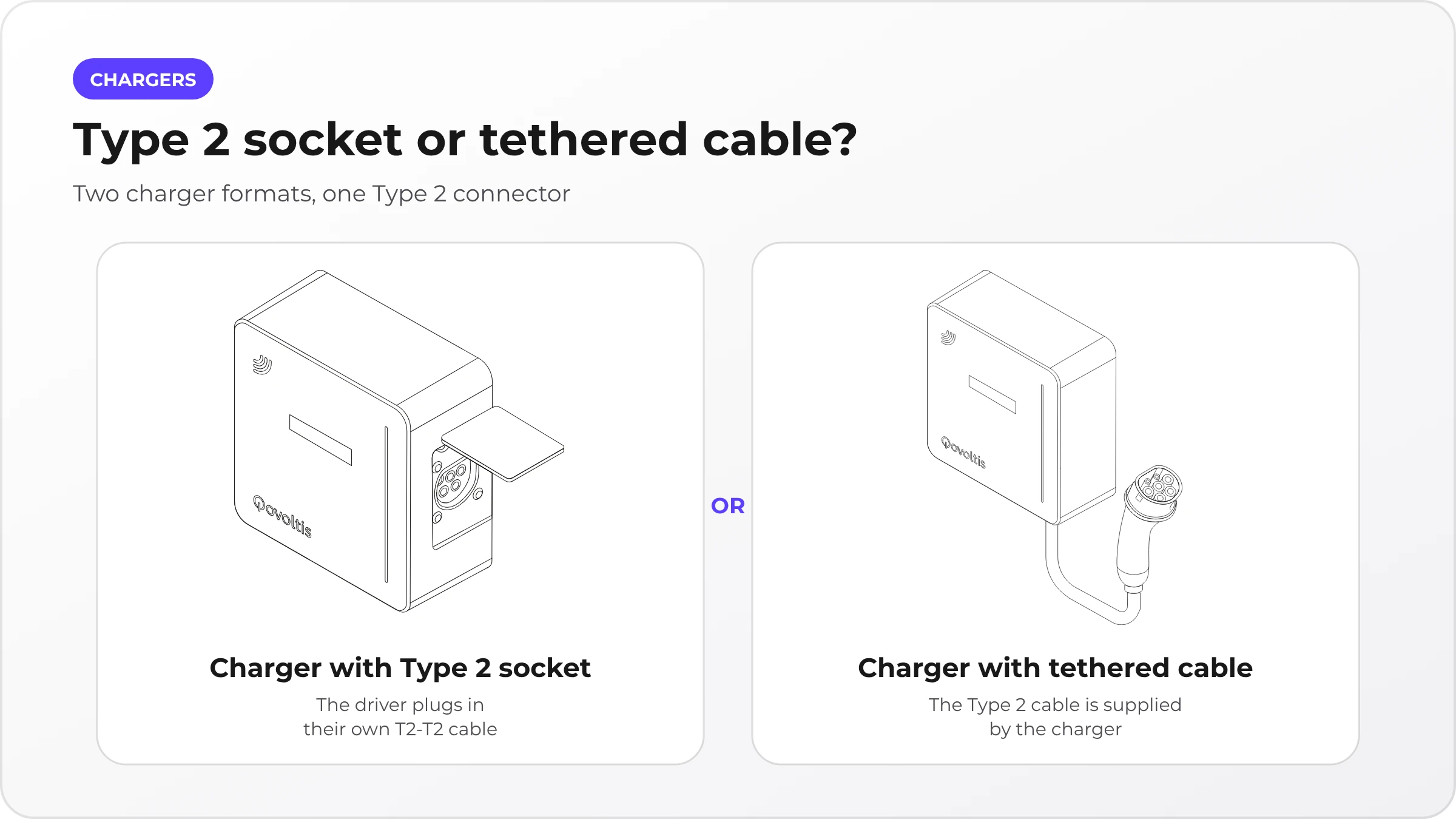
On the car, the Type 2 socket is behind the charging flap. On the charger side, it comes in two forms: a socket, into which you plug your own cable, or a cable attached to the charger.
Why is it also called a Mennekes connector or a T2 connector?
Mennekes connector and T2 connector are other names for the Type 2 socket. Mennekes is the name of the German manufacturer that proposed this connector in 2009; T2 is its common abbreviation, and T2S refers to its version fitted with shutters. You will come across these names in the data sheets of chargers and cables.
How do you recognise a Type 2 socket?
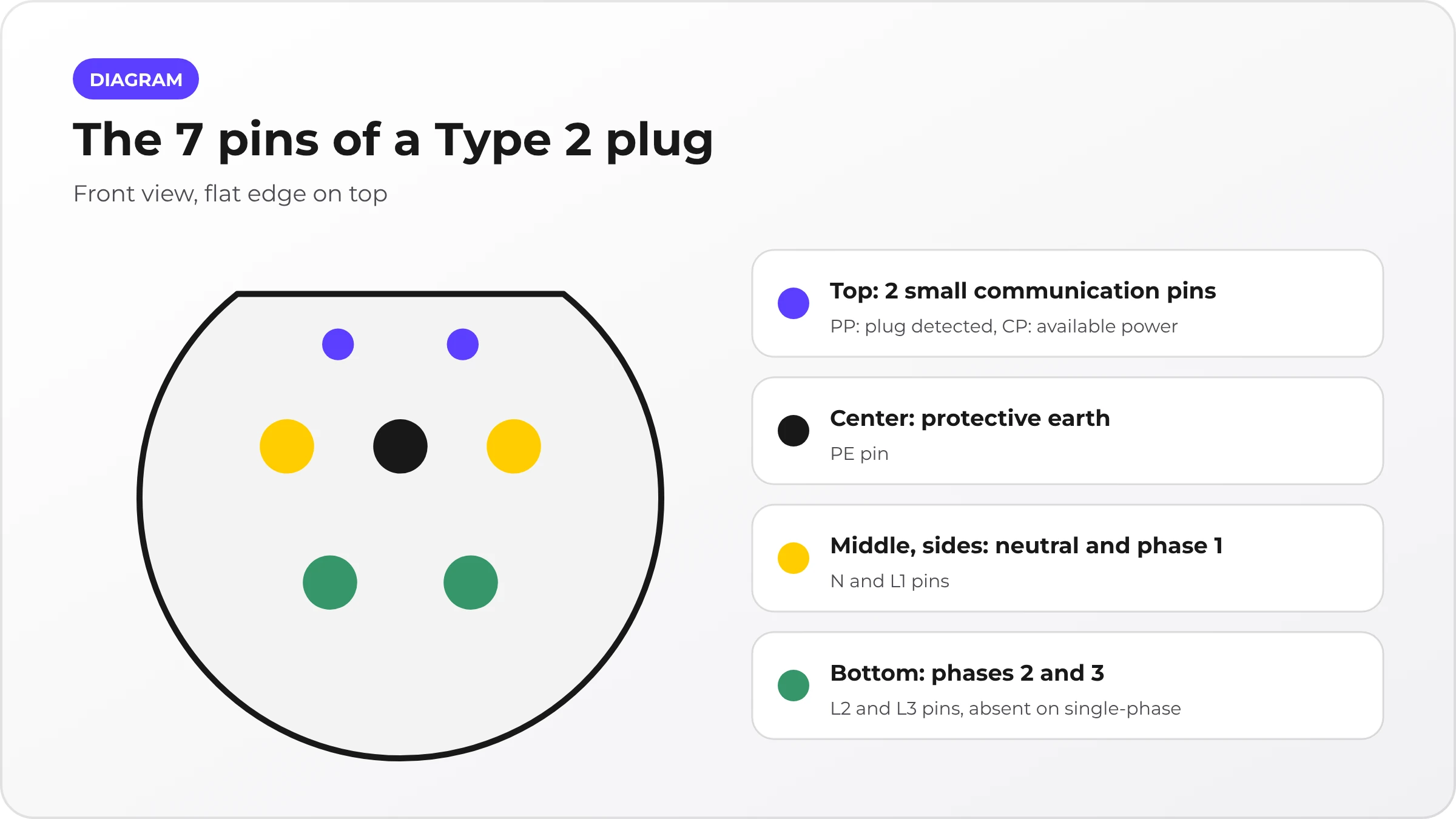
A Type 2 socket is recognised by its round shape with a flat edge at the top and by its 7 pins: 2 small communication pins at the top, and 5 larger ones below for protective earth, the neutral and up to 3 phases.
The proximity pin (PP) detects that the cable is properly plugged in; the control pilot pin (CP) indicates the available power before current flows. On some single-phase sockets or cables, the phase 2 and phase 3 pins may be absent.
How much charging power does a Type 2 socket deliver?
A Type 2 socket delivers 3.7 kW to 22 kW on most chargers: 3.7 or 7.4 kW single-phase (16 or 32 amps, 230 volts), 11 or 22 kW three-phase (16 or 32 amps, 400 volts). The car charges at the speed of the weakest link: charger, cable or onboard charger.
| Supply | Current | Maximum power | Energy recovered in 1 hour (theoretical, excluding losses) | Where you find it |
|---|---|---|---|---|
| Single-phase 230 V | 16 A | 3.7 kW | 3.7 kWh | Slow charging, low power |
| Single-phase 230 V | 32 A | 7.4 kW | 7.4 kWh | Home charger, employee car park, hotel |
| Three-phase 400 V | 16 A | 11 kW | 11 kWh | Business and hotel chargers; limit of many onboard chargers |
| Three-phase 400 V | 32 A | 22 kW | 22 kWh | Public car park chargers, short stops (1 to 3 h); about 2.5 hours for a 50 kWh battery, losses included, if the car accepts 22 kW |
These values are maximums. To choose according to your use, see our comparison of 7 kW vs 22 kW charging stations.
Why doesn't my car charge at 22 kW on a Type 2 charger?
A car does not charge at 22 kW on a Type 2 charger when its onboard charger accepts less: many models are limited to 11 kW on three-phase, some to 7.4 kW. The charger supplies at most its rated power, but it is the car that sets what it absorbs.
This is the case for most versions of the Tesla Model 3 and Model Y or the Volkswagen ID.3 and ID.4, limited to 11 kW on AC. Check the "AC charging" power in your car's data sheet.
Is the Type 2 socket mandatory in France and Europe?
Yes. European Regulation 2023/1804 (AFIR), applicable since 13 April 2024, requires normal-power AC charging points to be fitted with at least Type 2 sockets or connectors (article 21 and Annex II). In France, article 3 of Decree no. 2017-26 sets the same requirement for every normal-power AC charging point.
The AFIR regulation replaced Directive 2014/94/EU, repealed on 13 April 2024. Since 8 January 2026, newly installed or renovated points follow the 2022 version of the standard (Delegated Regulation 2025/656), except points of 3.7 kW or less designed for mode 2 charging, which may use a household socket. In France, a private home not open to the public can be limited to a type E socket (device of 3.7 kW or less), with the charging current limited to 8 A. The result for drivers: almost every car sold in Europe finds a compatible socket on any normal-power charger open to the public.
What is a T2S socket, and are shutters mandatory?
A T2S socket is a Type 2 socket fitted with shutters, flaps that cover the contacts when nothing is plugged in. In its original version, Decree no. 2017-26 required them for points connected to a building's delivery point; since 1 July 2022, it refers to the safety requirements of the NF C 15-100 standard.
At Qovoltis, the Qobox P has a T2S socket, and the Qobox mini exists both with a T2S socket and with an attached cable fitted with shutters.
What is the difference between a Type 2 socket and a CCS connector?
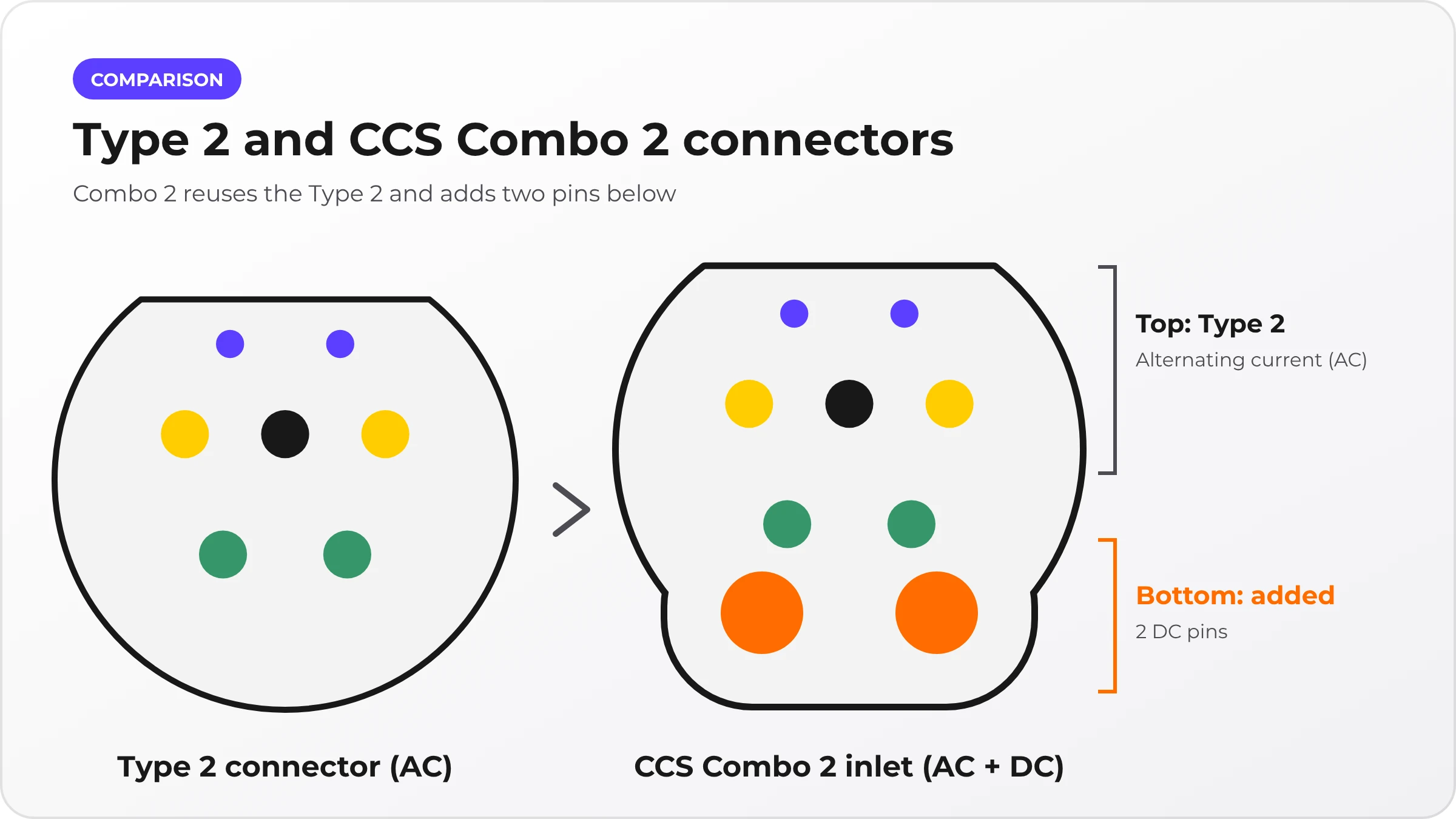
The Type 2 socket is used for AC charging, up to 22 kW on most chargers, with the driver's cable or the charger's own cable. The CCS connector (Combo 2) reuses the top part of the Type 2 and adds two large pins for direct current (DC): it is the European standard for fast charging.
On a compatible car, the Combo inlet accepts a Type 2 cable in its upper part and the CCS connector, always attached to the fast charger, across the whole inlet. The AFIR regulation requires Combo 2 on DC fast charging points, and article 5 of Decree no. 2017-26 does the same for those open to the public. Qovoltis installs only AC chargers, up to 22 kW.
What is the difference between Type 2, Type 1 and Type 3 sockets?
The Type 1 socket is a single-phase connector, limited to 7.4 kW on the European grid, common in North America, Japan and South Korea, and rare in Europe. The Type 3 socket, an older format used in France and Italy, has been replaced by Type 2, which French regulations require for normal charging.
If your car has a Type 1 inlet, you can charge on a Type 2 charger with a T2-T1 cable. For fast charging, CHAdeMO, the Japanese DC standard, is gradually being replaced in Europe by CCS.
Which cable should you use to charge with a Type 2 socket?
To charge on a charger fitted with a Type 2 socket, you need a mode 3 T2-T2 cable. If the charger has an attached cable, no personal cable is needed. The cable must support the target power: a single-phase cable limits charging to 7.4 kW.
Mode 3 is charging on a dedicated charger; mode 2 is the portable charger plugged into a household socket.
Which Type 2 charger should you install in a hotel or business car park?
In the car park of a hotel, campsite or business, every normal-power charging point must offer at least a Type 2 socket or connector, as required by Decree no. 2017-26: this is what lets almost every electric car sold in Europe plug in. The choice then comes down to power and format.
With Type 2 chargers, your guests and employees can plug in without any compatibility question. All Qobox chargers use this connector, up to 22 kW. Qovoltis has 3,000 active chargers and 500 hotel and leisure establishments equipped, and monitors the chargers remotely from its Qockpit platform.
Power is chosen according to parking time. For a hotel or an office space, Qovoltis recommends 7.4 or 11 kW chargers: a night more than covers a guest's need, a working day an employee's daily need (see our guide to EV charging stations for hotels). 22 kW makes sense for short stops of 1 to 3 hours. For a hotel, third-party investment lets you get equipped without investment, subject to conditions: Qovoltis finances, installs and operates the chargers. See also our solutions for businesses.
Should you choose a charger with a Type 2 socket or an attached cable?
A charger with a Type 2 socket, wall-mounted or on a post, requires each driver to plug in their own T2-T2 cable; a charger with an attached cable supplies the cable. Both comply with Decree no. 2017-26, which accepts a socket or a Type 2 connector.
At Qovoltis, the Qobox P and the Qobox E are fitted with a Type 2 socket, and the Qobox mini is available with a Type 2 socket or with a 5-metre attached cable.
FAQ
Are all electric cars compatible with the Type 2 socket?
Almost all electric and plug-in hybrid cars sold in Europe have a Type 2 or Combo CCS inlet on the vehicle side, which accepts a Type 2 cable. Exceptions are very rare: some older or imported models fitted with a Type 1 inlet, which charge on a Type 2 charger with a T2-T1 cable. The vehicle manual states which inlet is fitted.
Can you charge a car with a Type 2 socket from a household socket?
Yes, with a mode 2 charging cable that connects a household socket to the vehicle's Type 2 socket. Power remains much lower than with a Type 2 charger, which makes charging noticeably longer. For daily charging, a charger fitted with a Type 2 socket is better suited.
How long does it take to charge a car with a Type 2 socket?
Charging time with a Type 2 socket depends on the power the car accepts: a 22 kW charger supplies at most 22 kWh per hour, a 7.4 kW charger at most 7.4 kWh. For a 50 kWh battery, allow about 2.5 hours on a 22 kW three-phase charger, if the car accepts that power.
How do you charge at a Qovoltis charger with a Type 2 socket?
All Qovoltis chargers use the Type 2 connector: plug in your T2-T2 cable or the attached cable, then start the session by QR code with Scan to charge, with the Qovoltis app or with a badge. Scan to charge requires no account and no connection fees, with a €40 pre-authorisation on the bank card.
Let's talk about your charging project
Number of spaces, available power, usage: a Qovoltis expert sizes the Type 2 chargers suited to your site. Response within 48h.
Key takeaways
- The Type 2 socket is the European standard for AC charging, required by the AFIR regulation and by article 3 of Decree no. 2017-26.
- It delivers 3.7 kW to 22 kW on most chargers; actual power depends on the charger, the cable and the onboard charger.
- Fast DC charging uses the CCS connector (Combo 2), which reuses the shape of the Type 2.
- To equip a car park, every normal-power charging point must have a Type 2 socket or cable: this is the case for all Qovoltis chargers.
Further reading
- 7 kW or 22 kW charging station: what is the difference and which one to choose in 2026?
- How long until my electric car is charged?
- How do you charge at a Qovoltis charging station?
Sources and references
- Regulation (EU) 2023/1804 on the deployment of alternative fuels infrastructure (AFIR), articles 21, 25 and 26 and Annex II, EUR-Lex
- Commission Delegated Regulation (EU) 2025/656 of 2 April 2025 amending Regulation (EU) 2023/1804, EUR-Lex
- Decree no. 2017-26 of 12 January 2017 on infrastructure for charging electric vehicles, articles 3 and 5, Légifrance
Article updated in November 2026. Regulations checked at the date of publication on EUR-Lex and Légifrance. The powers stated are maximums: actual power depends on the charger, the cable and the vehicle.