Updated 10/08/2026
When an electric company car joins the fleet, the question soon arises: where will the employee charge it? In 80% of cases, the answer is at home, in the evening. Without dedicated equipment, this charging is done via a slow domestic socket—which is impossible to justify to tax authorities—or at public charging stations that are two to three times more expensive. For fleet managers, HR, or CFOs, the challenge is twofold: controlling the total cost of the fleet (what financial experts call TCO, or Total Cost of Ownership) and reimbursing the employee without creating tax or social security risks. The Qobox mini was designed for this specific scenario. Here is what it changes, how much it costs, and how its deployment works.
Why install a charging station at an employee's home instead of paying for public charging?
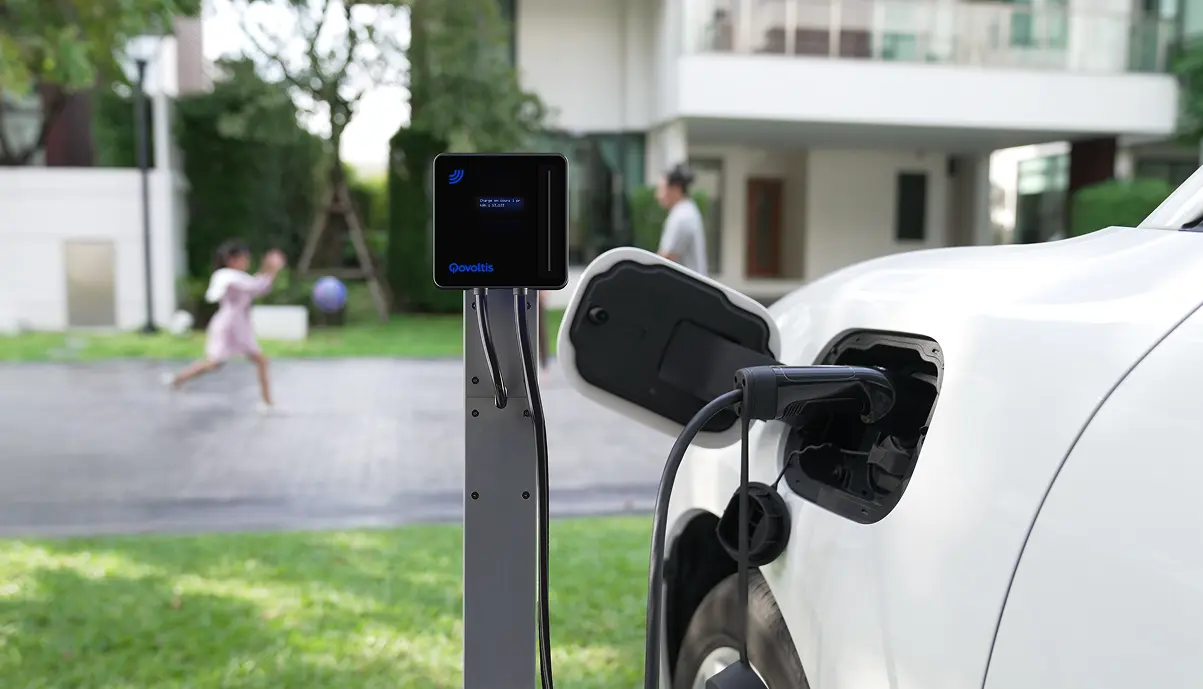
Because that is where the vehicle spends the night, and where electricity is cheapest. An electric company car is charged 80% of the time at the driver's home. If that home is not equipped, the company pays for this energy at public charging rates, which range from €0.38 to €0.85/kWh depending on the power and the operator (the details of rates and connection fees are explained in our article on the cost of electric charging). At home, the same kilowatt-hour costs an average of €0.26.
Across a fleet, the difference quickly becomes a significant budget item. According to the detailed case study in our guide on home charging for employees, organized home charging saves approximately €560 per vehicle per year. For 30 vehicles, that represents an annual saving of €16,800.
The charging station also saves the employee time. They plug in when they get home, leave in the morning with a full battery, and no longer have to look for an available public station or pay out-of-pocket expenses. For the company, it is a tangible retention tool when offering electric vehicles to hesitant employees.
What is the Qobox mini?
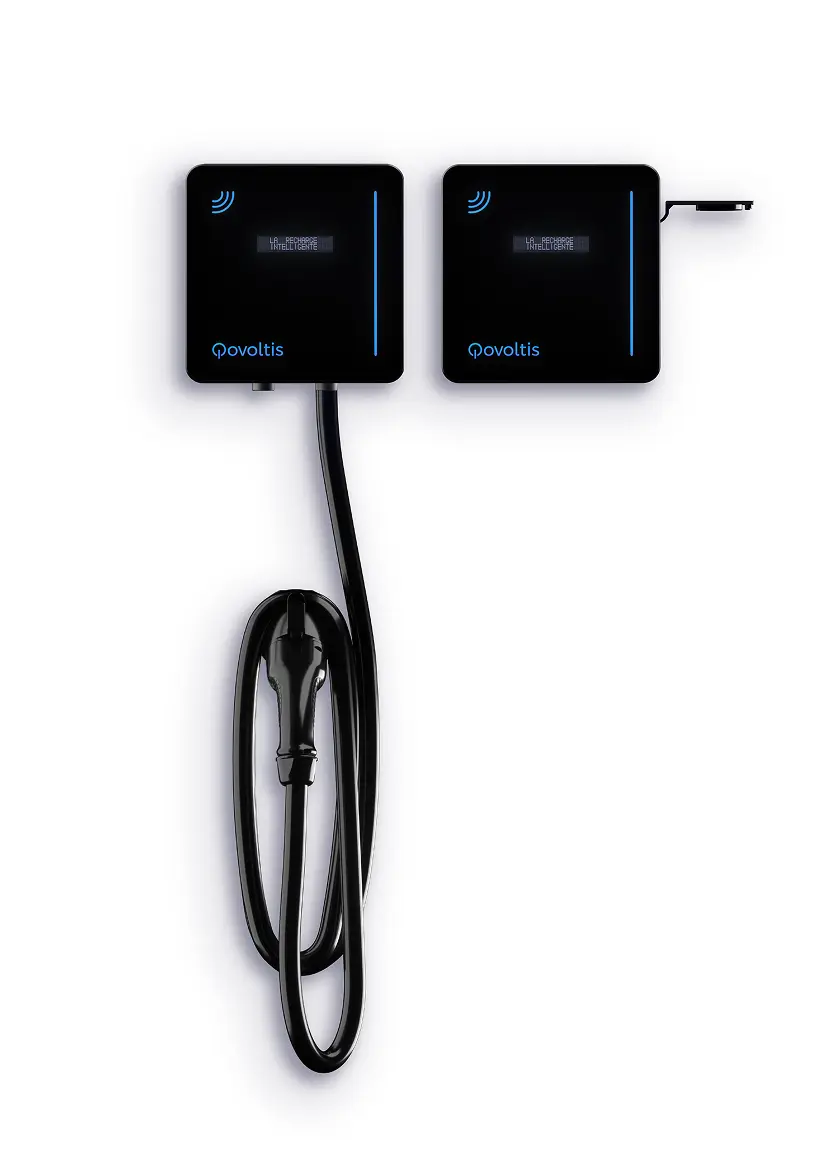
The Qobox mini is Qovoltis' wall-mounted charging station designed for residential use, specifically for employees' homes. Launched in 2023, it is manufactured in France, in the Sarthe region, and is certified "Origine France Garantie." Its compact 25 × 25 × 10 cm square design, weighing 5.5 kg, allows it to be installed in a garage, on an exterior wall, or under a shelter without major construction work.
What distinguishes it from a consumer-grade station is not its size, but what it measures and transmits:
- An integrated MID-certified meter. The European MID standard guarantees measurement accuracy: this is the requirement for the recorded kilowatt-hours to serve as proof for reimbursement.
- A permanent connection (Wi-Fi, Ethernet, or Powerline communication) that uploads every session to Qockpit, the Qovoltis supervision platform.
- Integrated protection : type B residual current device, which detects leakage currents specific to electric vehicles, with no additional box required for the electrical panel.
- Three ways to start a charge : the Qovoltis app, an RFID badge, or a QR code.
- Open compatibility : OCPP 1.6 protocol, the communication standard between charging stations and management platforms, and the ISO 15118-20 standard.
In terms of durability, the charging station is IP55 rated (protected against dust and water jets) and operates from -25°C to +55°C. It comes with a 24-month warranty, including customer support and predictive maintenance: Qockpit flags any issues before the employee is left without a charge.
Comparison of charging solutions for an electric company car
*If the home is connected to a three-phase power supply and the vehicle's onboard charger accepts 22 kW. kWh costs: averages taken from the Qovoltis home charging guide for employees.
How does the Qobox mini separate professional and personal charging?
By measuring each session with its MID-certified meter and assigning each charge to a specific usage. The employee pays for the electricity through their own contract, just like the rest of their consumption. The station records the kilowatt-hours for each session, the employee indicates in the Qovoltis app whether the charge was professional or personal, and the professional portion is calculated automatically.
For the employer, this results in individual statements available in Qockpit: consumption per employee, session history, and amounts to be reimbursed. Reimbursement is then handled through the standard expense report process. The employee does not need to keep manual records, provide estimates, or sort through invoices.
Why is this important? Because the URSSAF allows the reimbursement of professional expenses provided they are justified. Charging via a standard domestic outlet mixes with the home's overall consumption, making it impossible to prove what pertains to the company vehicle. With certified and separate metering, the reimbursement is treated as a reimbursement of actual expenses, rather than as a taxable benefit. The three ways to reimburse an employee (actual expenses, direct payment by the employer, mileage allowances) are detailed in our article on home charging reimbursement.
What power level should be chosen for an employee's home?
In the vast majority of cases, 7.4 kW single-phase is sufficient. This is the maximum power for a home with a single-phase connection, and it charges a 50 kWh battery in about 7 hours: more than enough to start the morning with a full charge after being plugged in overnight. Three-phase power, up to 22 kW, is only useful if the home is already equipped for it and the vehicle supports it, which remains rare for common fleet models.
Two features of the Qobox mini prevent the need to oversize the installation:
- Power modulation. The station adjusts its power in real-time based on the home's consumption. If the oven, water heater, and stovetop are running at the same time, it reduces the charging speed instead of tripping the house's circuit breaker. The employee does not need to increase their electricity subscription.
- Charging during off-peak hours. The charging station can be programmed to charge when electricity is cheapest. With an off-peak/peak rate contract, this means less to reimburse.
Everything is configured remotely via Qockpit: the company doesn't need to send a technician to change settings, and the fleet manager retains control over all installed stations, regardless of their location.
Who pays for the charging station and what are the tax rules for 2026?
The equipment is funded by the employer. The cost depends on the distance between the electrical panel and the station's location, as well as the condition of the existing installation: this is what the preliminary technical survey determines. The company can also spread out the investment through a leasing or credit solution over 3 to 5 years with BNP Paribas, including equipment and services.
Regarding taxes, everything depends on who retains ownership of the station:
- The station remains the property of the company and is returned to it when the employee leaves: there is no benefit in kind. This is the simplest arrangement to manage.
- The employee keeps the station : the employer's contribution is 50% exempt, up to a limit of €1,057.10 in 2026, for a station less than 5 years old; and 75% exempt, up to a limit of €1,585.50, for a station 5 years old or older.
- Electricity paid for by the employer to charge an electric company vehicle is not included in the calculation of the benefit in kind until December 31, 2027.
These amounts are set by the order of February 25, 2025 and are adjusted annually. For the full calculation of the benefit in kind for the vehicle itself, consult our guide to benefits in kind for electric cars and charging stations.
What happens if the employee is a tenant or leaves the company?
Being a tenant does not prevent installation. The "right to a plug," provided for byArticle L113-16 of the Construction and Housing Code, allows a tenant to have a charging station installed at their own expense (or that of their employer) after informing their landlord. It also applies to rented single-family homes. The procedure, response time, and the only valid grounds for refusal are detailed in our article installing a charging station for an employee who is a tenant.
When an employee leaves, the charging station remains the property of the company. Qovoltis handles its removal or transfer to another employee. The terms (ownership of the equipment, return, end of reimbursement) must be set out in a written agreement signed when the vehicle is handed over; this document protects both parties in the event of an audit or disagreement.
How does the deployment process work for your employees?
In four steps, in less than 30 days from the purchase order:
- Online qualification. Each employee completes a technical questionnaire on their smartphone regarding their housing type, electrical panel, and parking access.
- Remote technical assessment. A Qovoltis expert validates feasibility and defines the installation requirements for each address.
- Consolidated quote. The company receives a single quote for all home locations within 48 hours, with one single invoice.
- Installation. An IRVE-certified technician installs the Qobox mini on-site in under 30 minutes, commissions the station, and activates it in Qockpit.
For the company, a single point of contact manages the equipment, installation, supervision, and maintenance, whether the fleet consists of 5 or 200 vehicles. If some employees also charge at the company parking lot, the same tracking tools cover the charging stations installed on-site.
FAQ
Which charging station should be installed at an employee's home?
A wall-mounted station with a MID-certified meter, such as the Qobox mini. This meter measures charging separately from the rest of the home, allowing the employee to be reimbursed for the actual cost of electricity in compliance with URSSAF regulations. In single-phase, a 7.4 kW power output charges a 50 kWh battery in approximately 7 hours.
Who pays for the charging station installed at an employee's home?
The employer, in the vast majority of cases. If the station remains the property of the company, it does not create a taxable benefit in kind. If the employee keeps it, the coverage is 50% exempt up to a limit of €1,057.10 in 2026 (for a station less than 5 years old), or 75% up to a limit of €1,585.50 (for a station 5 years or older).
How can I get a quote to equip my employees' homes?
Each employee completes an online technical questionnaire, after which a Qovoltis expert validates feasibility remotely. Within 48 hours, the company receives a consolidated quote for all homes, with a single invoice. The amount depends on the electrical installation of each property and the distance to the charging station location.
Can an employee who is a tenant have a charging station installed?
Yes. The "right to a plug" (Article L113-16 of the Construction and Housing Code) allows a tenant, including those in single-family homes, to have a station installed after notifying their landlord. Qovoltis verifies technical feasibility during the preliminary assessment.
Key takeaways
- 80% of charging for an electric company vehicle takes place at the employee's home: this is where the fleet's energy costs are determined.
- The Qobox mini (up to 22 kW, MID meter, remote management) measures each charge separately and enables reimbursement based on actual usage in compliance with URSSAF regulations.
- At an average of €0.26/kWh compared to €0.38 to €0.85 for public charging, home charging saves approximately €560 per vehicle per year.
- A charging station that remains the property of the company does not generate any benefit in kind; electricity is excluded from this until December 31, 2027.
- Deployment in under 30 days, consolidated quote within 48 hours, including for employees who are tenants.
Learn more
- Charging stations at employees' homes: installation, taxation, and reimbursements (2026)
- Electric vehicle and charging station benefits in kind
- Installing a charging station for an employee who is a tenant
- Electric charging prices: how much does a charge cost and how is it billed?
- Corporate charging stations: obligations, costs, and 2026 solutions
- Qobox mini product sheet
Sources and references
- Order of February 25, 2025, regarding the valuation of benefits in kind, Légifrance
- Article L113-16 of the Construction and Housing Code (right to a plug), Légifrance
- Benefits in kind, Official Social Security Bulletin (BOSS)
- 2026 vehicle benefit in kind, LégiSocial
Information verified as of the article's update date. This does not constitute legal, tax, or social advice: rates are revised annually; please consult your accountant or URSSAF regarding your specific situation.