Silent, non-polluting, economical to use, minimal maintenance… Electric cars offer benefits increasingly favored by French consumers and allow for significant savings. No more expensive gasoline or diesel fill-ups: these vehicles run on electricity and can be easily charged at dedicated stations. How much does it cost to charge an electric car? What's the price difference between a home charging station and a public one? Qovoltis answers your questions.
The cost of charging an electric car at home
The cost of a full electric car charge depends on several factors, including your vehicle's battery capacity, your car's model, and the price per kWh.
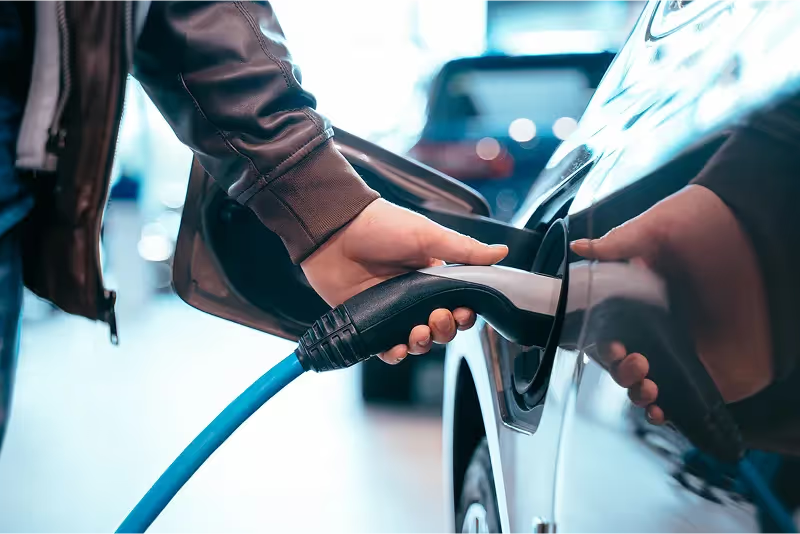
Home charging is currently the most practical and economical option and is done via an installed charging station. The cost of charging then depends on the price per kWh set by your energy provider.
On average, an electric car consumes between 12 and 24 kWh per 100 km. To calculate the electricity cost of charging, multiply the number of kWh consumed by the current kWh rate set by your energy provider.
For example:
- If the electricity rate is €0.1798 including tax during peak hours and €0.1344 including tax during off-peak hours in 2020 (EDF "tarif bleu");
- If your car consumes 18 kWh/100 km and charging is done during off-peak hours:
18 x 0.1344 = €2.42 of electricity / 100 km
Generally, expect between 3 and 12 euros of electricity for a full vehicle charge.
Which charging method should you choose for your electric vehicle?
While it's possible to charge your electric car using a standard household outlet, this solution is not recommended. The reason? This type of outlet is generally not suitable for such use (charging time will be very long and more expensive), and you also risk damaging your electrical installations or even starting a fire. It is advisable to opt for a suitable and efficient charging station, which is a more beneficial long-term solution.
Charging at a dedicated station is now more practical and economical; it also best preserves electric vehicle batteries. Indeed, it's good to know that battery lifespan greatly depends on how they are charged. At a charging station, your vehicle charges at a rate fast enough to fully recharge your vehicle in a few hours, but slow enough not to overheat it. Heat significantly damages batteries, which is why superchargers cannot be used frequently. Therefore, it's not feasible to charge your vehicle solely with superchargers.
The cost of charging an electric car at public charging stations
It is also possible to charge your electric car at publicly accessible charging stations. For paid charging stations, each operator is free to set their own pricing structure. To save on charging costs, it's essential to compare the different networks (Corri-Door, CNR, Belib’ Paris, etc.) and the rates they offer. Most of the time, the price of charging in France is determined based on the time spent, and not on the number of kWh delivered.
It is therefore difficult to establish a price range for the cost of charging at a public station. This depends on the operator and their rates, with options ranging from 50 cents for 5 minutes to 4 euros for 15 minutes. To save on charging costs and get better prices, it can be beneficial to use a specific pass/badge depending on the chosen network, or to find a station that bills per kWh consumed. The latter solution is the most advantageous and transparent.
Other factors also come into play, such as the charging station's power output or the vehicle's charging capacity. Most operators indeed charge by duration, regardless of the station's power output and thus the power delivered. The main drawback? If the charging station or the vehicle has limited power, the charging time will be longer and consequently more expensive.
Billing per kWh consumed remains the most economical and fairest option for drivers. Indeed, for the same duration, a 3 kW charging station will deliver much less energy to your vehicle than a 22 kW station. This is why minute-based pricing can be unfair depending on how quickly your car accepts the charge, whereas kWh billing ensures you only pay for the energy actually transferred to your battery.
Charging speed also depends on your vehicle. Therefore, remember to check its specifications: manufacturers generally offer AC charging powers of 7.4 kW, 11 kW, or 22 kW.
Your electric car's model also matters, as the more it consumes, the higher the charging cost will be. Its most impactful factor? Your vehicle's weight and your driving style. Consider this beforehand when making your purchase.
Finally, some vehicles offer economic modes. The principle: the electric car recovers maximum energy during deceleration phases by recharging the battery. This is often referred to as one-pedal driving, where the accelerator allows you to both accelerate and slow down.
Did you know?
The State has set a goal of installing 7 million charging stations by 2030. To achieve this, companies are now required to equip their parking lots with charging stations accessible to their employees. Aid through the 'Advenir program' is available for businesses and condominiums to finance the purchase and installation of their charging stations.
Today, efficient solutions exist to give you access to advantageous electric car charging offers. Qovoltis offers innovative charging stations and a service that allows you to manage your charging with two charging modes: fast, to charge the battery as quickly as possible, or optimized, to charge your vehicle at the lowest possible cost. This is an opportunity to reduce electricity costs for charging your car and ensure a charge under the best conditions, safely.
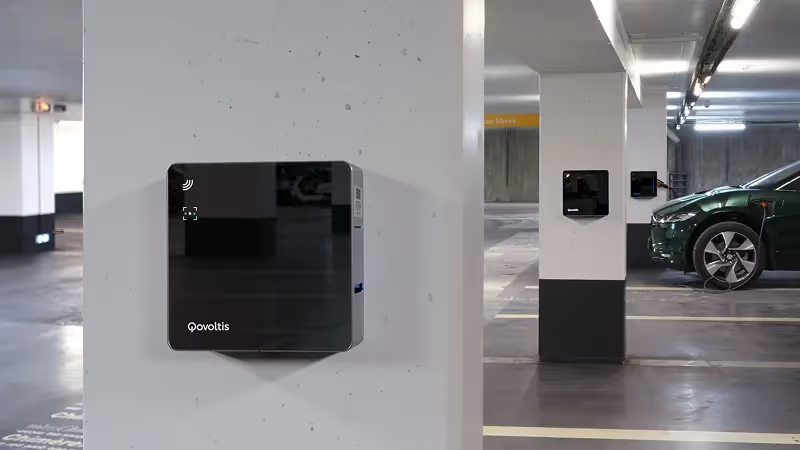
For individuals, condominiums, businesses, public car parks… Qovoltis offers electric vehicle charging stations capable of adapting their power in real-time based on the available power from the electrical installation, as well as advantageous pricing per kWh consumed.