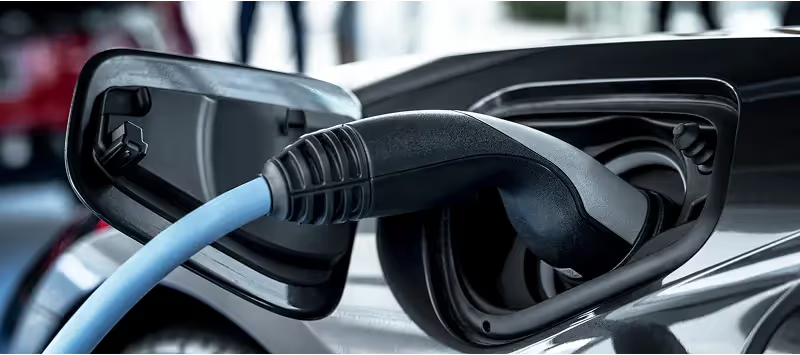
Today, electric cars are sold with one cable, sometimes even 2: the first is adapted to type E sockets (domestic) and the second to type 2 sockets. In general, buying a cable is only necessary if your vehicle is old, or if your cable is damaged. To take advantage of a cord that meets your needs, it is necessary to choose it carefully. Vehicle model, desired power, type T2 plug... What factors should you take into account when choosing the right charging cable? Our advice
The European standard: the type 2 plug
In France, all vehicles sold are equipped with a power outlet type 2 — with 7 connectors — which allows slow or fast charging or on a supercharger. It delivers a power of between 3 and 43 kW. This is the standard dedicated to electric charging, both for vehicles and charging stations. Your charging cable must therefore be Type 2
Some electric vehicles also include connectors that allow for fast charging, such as the Combo socket (the European standard) or CHAdeMO. The type 2 socket also allows you to connect to superchargers (the latter generally have 2 sockets).
Before you start buying your charging cable, make sure that it is well adapted to the socket of your electric car, that of your terminal and to the standards in force.
The charging station
In March 2017, France adopted the type 2 connector as the European plug standard for charging stations. This concerns normal charging stations (from 3.7 kW to 22 kW), whether they are:
- standards: 3.7 to 11 kW;
- accelerated: 22kW.
Charging stations installed after this date are now all equipped with a type 2 (T2S) base, whether public or private.
Although it is possible to recharge your electric car on a domestic outlet, this solution is nevertheless not recommended and very slow. While the domestic outlet may have sufficient power to charge a vehicle, it is not intended to deliver such power over time. This can thus damage your electrical installations, create breakdowns, or even cause fires.

Also, if the household outlet has too low power, your car won't recognize it and won't be able to be charged. To recharge your vehicle safely and optimally, the use of a charging station is therefore recommended.
Did you know that?
Smart charging stations Qovoltis have the T2S socket base (type 2) which corresponds to the European standard. All electric vehicles and plug-in hybrids are thus compatible with this solution.
The desired length
The choice of the length of the charging cable depends mainly on 3 factors:
- the distance between the plug of your electric car and that of your charging station;
- your parking preferences;
- the size of your vehicle.
However, there is a standard for cable length, namely 5 meters.

A length of 4 meters is sufficient if you are used to parking near your terminal. On the other hand, if you want to maintain more freedom to park (forward/reverse for example) or if you have a large vehicle, a length of 7 meters is recommended.
Good to know :
An electric car charging cable can be purchased on specialized sales sites or from car dealerships. Its cost depends on its characteristics such as its power (a single-phase cord is cheaper than a three-phase cord), its length, etc. On average, the price is between €200 and €400.
The model of electric car charging cable The most common is Type 2. It is a versatile cord that can be used with electric and hybrid vehicles, and on domestic and public charging stations.